Key Takeaways
- The right portable room divider depends on your setting — from budget curtain panels to professional retractable screens
- Healthcare, government, and corporate settings each have distinct requirements that decorative dividers rarely meet
- Clinical and shared-use environments require non-porous, wipe-clean surfaces with locking casters for safety and compliance
- Retractable panel screens deploy faster, store more compactly, and cover more area than traditional folding designs
- Surface material is the single most important factor for any shared or high-traffic setting
Types of Portable Room Dividers
Not all portable dividers are created equal, and choosing the wrong type for your setting is the most common mistake buyers make.
The Five Main Types
| Type | Best For | Portability Level |
|---|---|---|
| Folding/bi-fold screens | Studios, temporary workspace division, home offices | High |
| Freestanding shelving units | Home offices, semi-permanent zone division | Medium (semi-permanent) |
| Retractable panel screens | Offices, healthcare, schools, events | Very high |
| Wall-mounted retractable screens | Exam rooms, dialysis bays, fixed clinical stations | Low (position-fixed) |
| Plant/fabric walls | Corporate lobbies, wellness rooms, open-plan offices | Medium |
How Material Affects Function
Material choice determines far more than appearance:
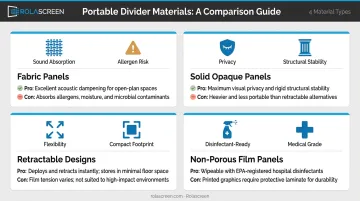
- Fabric panels absorb some ambient sound but can harbor allergens and bacteria over time—and most cannot be disinfected with anything stronger than a mild cleaner
- Solid opaque panels offer genuine visual privacy and structural stability, though heavier models sacrifice quick repositioning
- Retractable designs use tension-based mechanisms to extend and retract into a compact footprint, making them the most flexible option for spaces where configurations change regularly
- Non-porous film panels (used in medical-grade screens) wipe clean with EPA-registered hospital disinfectants, including bleach and accelerated hydrogen peroxide—critical for any clinical or high-traffic setting
One practical note on portability: a freestanding bookshelf technically qualifies as "portable," but repositioning it daily is neither practical nor efficient. True portability means reconfigured in seconds — not a 10-minute furniture move.
Portable Room Divider Ideas for Home Spaces
Studio Apartments and Small Spaces
Studios averaged just 457 square feet in 2024, which doesn't leave much room for bulky permanent structures. The dividers that work best in these spaces share one trait: they take up almost no floor footprint when not in use.
Best options for studios:
- Sheer fabric curtain panels hung from ceiling-mounted tension rods create a sleeping zone without blocking light—the most affordable approach
- Mirrored folding screens separate spaces while reflecting light, making a small room feel larger rather than more cramped
- Vertical plant stands arranged side by side form a living wall partition that adds greenery and visual interest without consuming meaningful square footage
For renters who can't drill into walls, a tension rod and sheer curtain panel is genuinely the smartest starting point. The whole setup costs under $100 and comes down in minutes.
Home Offices and Dedicated Work Areas
A cross-sectional study of 271 technology employees found that home workspace noise had a strong association with distraction (beta = 0.44), and that having a dedicated work area was linked to less distraction overall. Visual separation helps signal to both the brain and household members that work is happening.
Two practical approaches:
- Open-backed freestanding bookshelf placed perpendicular to a wall simultaneously divides the space and provides storage on both sides—no drilling required
- Lightweight folding privacy screens create a visual background for video calls and fold flat when the workday ends—ideal for living rooms doubling as offices
Living Rooms and Open-Concept Floors
Open floor plans benefit most from dividers that define zones without closing them off entirely.
- Floor-to-ceiling curtain panels between a dining area and living room add height, texture, and zone definition at the lowest cost of any divider type
- Macramé or woven panel dividers work well in eclectic or bohemian interiors—they provide visual separation without fully blocking sightlines or natural light
The right divider depends less on room size and more on how permanently you need the separation. The next section covers options built for spaces that require daily reconfiguration.
Portable Room Dividers for Offices and Workspaces
Open-plan offices create real problems beyond aesthetics. A controlled experiment with 43 participants found that open-plan office noise increased negative mood by 25% and physiological stress by 34% compared to quieter conditions.
Portable panel dividers address this without requiring facilities teams to undertake construction. Key applications include:
- Individual workstation screens that reduce visual distraction and create a sense of personal space
- Acoustic panels that absorb ambient sound—when evaluating these, ask for product-specific NRC ratings rather than accepting category-wide claims, and note that NRC (absorption) and STC (sound transmission loss) measure different things
- Temporary meeting rooms and quiet zones for co-working spaces, conference setups, and hybrid office layouts where configurations shift week to week
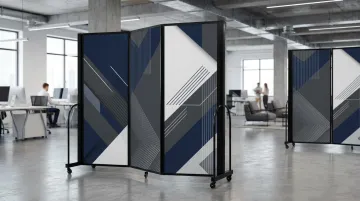
Branded retractable screens add another dimension in corporate settings. Ubisoft, for example, used printed panels to create a pop-up yoga studio inside their Silicon Valley offices, with imagery pulled from their game titles. The screens served as both functional dividers and brand expression in one.
That kind of flexibility reflects a broader shift: 56% of organizations in JLL's 2024 Future of Work Survey were classified as hybrid adopters, sustaining demand for layouts that can be reconfigured without permanent construction.
Portable Room Dividers for Professional and High-Traffic Settings
Why Standard Options Fall Short
Folding screens and fabric curtains fail in healthcare, education, and emergency settings for predictable reasons:
- Fabric panels cannot be reliably disinfected with hospital-grade products
- Research shows fabric privacy curtains can become contaminated with pathogens like MRSA within days of installation
- Standard folding screens lack the structural stability needed for high-traffic corridors
- Neither type retracts to a compact footprint when not in use
These aren't minor inconveniences. In clinical environments, the surface material of a privacy partition is an infection control decision.
Retractable Panel Screens as the Professional Solution
Purpose-built retractable screens solve what decorative dividers can't:
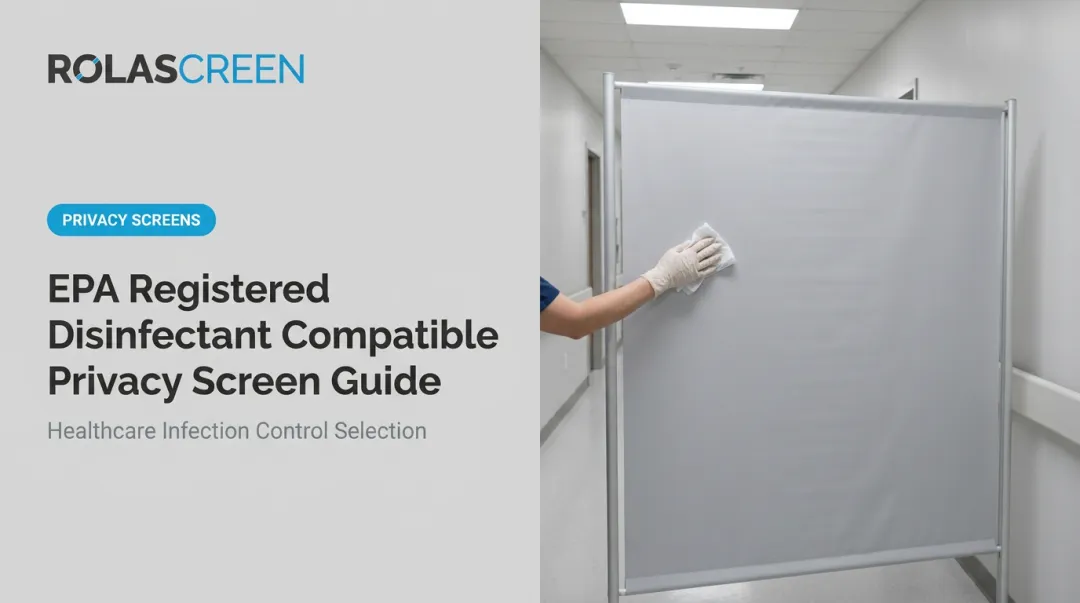
- Non-porous, wipe-clean surfaces compatible with EPA-registered hospital disinfectants
- Locking casters that secure the screen during patient care, releasing with a foot pedal — no bending, no hands required
- Single-person operation from repositioning to full extension in seconds
- Large coverage area that retracts to a compact storage footprint
Rolascreen's Portable Elite, manufactured in Chatsworth, California, extends to 123 inches (10'3") wide and is available in 6'3" or 5'3" heights with custom options. The non-porous thermally-stabilized medical-grade polyester film panels can be wiped down with bleach, quats, or accelerated hydrogen peroxide between patient uses.
Real-World Deployments
The scale of professional demand for this type of product is significant:
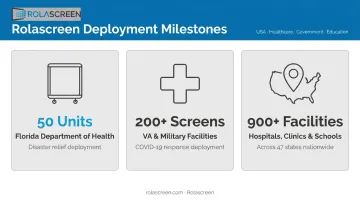
- 50 portable units delivered to the Florida Department of Health for disaster shelter use within 4 weeks
- 200+ screens supplied to VA and military facilities during COVID-19, including Wilmington VA Medical Center, Delaware VA Hospital, and VA Gulf Coast—used for infection containment, patient privacy, and vaccine center partitioning
- 900+ hospitals, clinics, and schools across 47 states served since rebranding in 2019
Healthcare clients include Kaiser Permanente, UCSF, UCLA, Atrium Health (15+ facilities), Dignity Health, Montefiore, and NYC Health + Hospitals.
HIPAA and Regulatory Context
The compliance requirements driving these deployments are real. HHS requires covered entities to apply reasonable safeguards to protect Protected Health Information. While HHS doesn't prescribe a specific screen height or design, solid panel construction that prevents visual observation in shared treatment areas is a practical implementation of that requirement, particularly in emergency departments, dialysis bays, and open-bay recovery units.
The 2022 FGI outpatient guidelines formally recognize portable privacy screens as a valid patient-care space enclosure method, alongside traditional cubicle curtains.
Customization in Professional Settings
Standard folding screens offer no customization. Purpose-built retractable screens can be printed with:
- Facility branding and logos
- Wayfinding cues for large open spaces
- Calming artwork for patient-facing environments (Dignity Health Mercy Hospitals uses beach-scene panels in their ED)
- Military branch insignias for VA facilities
Custom-branded Rolascreen units typically ship in 3–6 weeks from artwork approval. Non-printed units ship in 10–30 days, with expedited options available.
What to Look for in a Quality Portable Room Divider
Whether you're outfitting an emergency department, a dialysis bay, or a corporate wellness room, the wrong divider creates more problems than it solves. These are the factors that actually determine whether a unit performs in the field:
Stability and weight
- Locking casters or weighted bases prevent tip-over
- Hinges should hold panels in position without requiring props or leaning
- For professional settings, foot-pedal caster locks are the practical standard
Stability matters most in high-traffic spaces where the divider gets repositioned daily. Hygiene is the next critical filter — especially in any shared or clinical environment.
Surface material and cleanability
- For any shared environment, non-porous surfaces are required for infection control
- Fabric panels look attractive but trap allergens and can't be properly disinfected
- Ask specifically what disinfectants are compatible before purchasing for a clinical setting
Coverage area and height
- Measure before buying—confirm the divider reaches sufficient height for actual visual privacy (at least eye level when seated or standing, depending on use)
- Check whether panels can link or extend to cover required width without gaps
Portability features
- Rolling casters for repositioning; locking mechanisms for stability
- Compact fold or retract dimensions for storage
- For emergency or event use, assess whether the unit ships assembled and what setup time looks like
Lead times
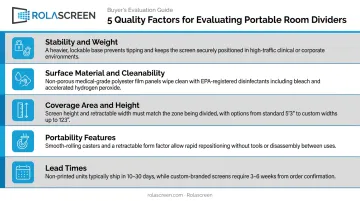
- For non-custom units, 10–30 days is a reasonable window
- Custom-branded orders require more planning lead time due to design approval and printing
Tips for Using Portable Room Dividers Effectively
Three placement principles that make a meaningful difference:
- Position dividers perpendicular to the longest wall to maximize the usable zone created on each side
- Keep heavy freestanding dividers out of high-traffic corridors—they're a safety hazard when people are moving quickly
- Use area rugs to reinforce zones even when the divider is temporarily moved—the rug anchors the spatial logic visually
In professional settings—clinics, offices, or classrooms—dividers work best when they're woven into the room's workflow rather than deployed as afterthoughts. Pair them with clear signage or branded panels so staff and visitors understand the spatial boundaries at a glance. A divider that serves a visible purpose stays in position; one that lacks context gets moved or ignored.
Frequently Asked Questions
What are some clever portable room divider ideas?
Retractable screens for clinical and commercial use, folding screens for flexible office setups, freestanding partitions for open-plan workspaces, and printed privacy panels for branded environments. The most effective solutions serve double duty—dividing space while also reinforcing wayfinding, displaying branding, or enabling quick reconfiguration without construction.
What is the best type of portable room divider for a small space?
Retractable screens and folding panels work best for small professional spaces because they have a minimal floor footprint, retract or fold flat when not in use, and don't reduce natural light the way permanent walls do. In offices or clinics where space is tight, a wall-mounted retractable screen offers the smallest footprint of all—it stores flush against the wall until needed.
Can portable room dividers be used in commercial or professional settings?
Yes, but professional environments require purpose-built dividers with locking casters, non-porous wipeable surfaces, and adequate height. Decorative folding screens won't hold up to repeated disinfection or the demands of high-traffic clinical settings. Purpose-built retractable screens—like those Rolascreen manufactures for hospitals, VA facilities, and corporate offices—are designed specifically for these conditions.
How do I keep a portable room divider stable and prevent it from falling?
Look for units with locking casters or anti-tip bases, position panels in a slight S or zigzag configuration rather than a straight line, and confirm the floor surface is level before deployment. A straight-line configuration is the most common cause of tip-over in freestanding dividers.
Are retractable room dividers better than folding screens?
For commercial and high-traffic use, yes. Retractable screens deploy faster, store more compactly, and offer greater flexibility in coverage length—some models extend to over 10 feet wide from a single unit. They're also easier to wipe down between uses, which matters in healthcare, education, and government settings where hygiene standards apply.
How do I choose the right portable room divider for my needs?
Consider the setting (clinical, corporate, or government), required height and width, surface material for hygiene or aesthetics, repositioning frequency, and budget. Start with your non-negotiables—if infection control matters, surface wipeability rules out most decorative options immediately.