 Skip to content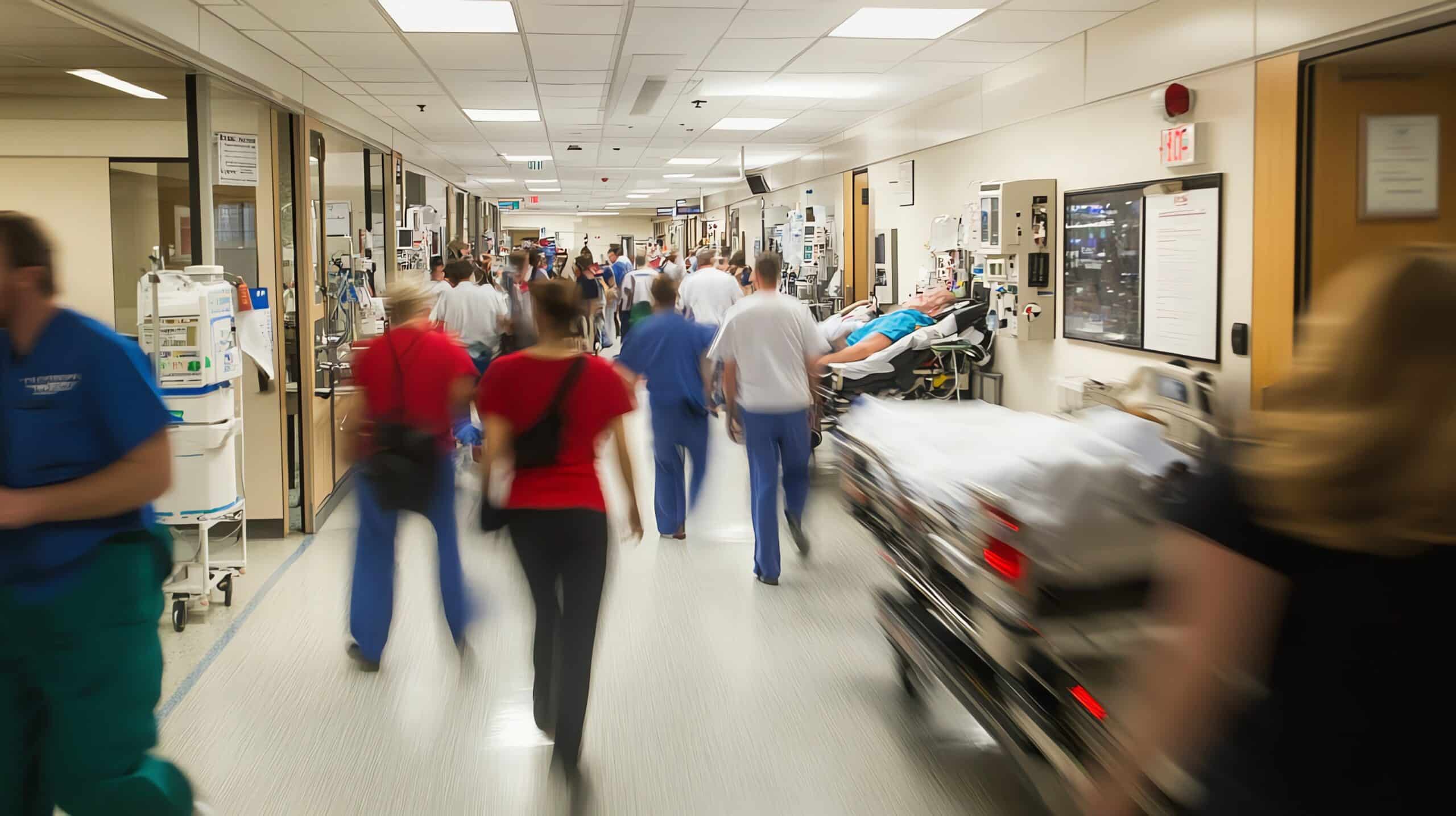
Temporary Hospital Privacy Screens
Privacy barriers for renovation zones, seasonal overflow, short-term clinical expansion, and event-based healthcare. Deploy in seconds, use for days or months, recover for the next project. No construction, no ceiling tracks, no permanent footprint.
Get a QuoteWhen Your Facility Needs Privacy — But Not Permanently
Not every privacy barrier needs to live in the building forever. Hospitals, clinics, and health systems face dozens of situations where they need clinical-grade privacy for days, weeks, or months — then need it gone.
A renovation that reroutes patient flow through a temporary corridor. A flu season that overflows the ED into a hallway. A vaccination campaign that converts a cafeteria into a clinic for three weeks. A construction project that forces an ICU to operate in a temporary space for six months. In every case, the facility needs privacy barriers that meet clinical standards — infection control, HIPAA compliance, disinfectant compatibility — but don't require the timeline or cost of permanent infrastructure.
Permanent construction takes permits, contractors, and weeks. Ceiling-tracked curtains require installation and leave hardware behind when removed. Temporary fabric barriers accumulate pathogens and can't be disinfected between patients. A portable retractable partition solves the problem differently: it deploys in seconds, cleans with EPA-registered disinfectants, provides rigid acoustic and visual privacy, and nests into storage when the temporary need passes.
Four Scenarios Where Temporary Screens Earn Their Place
Each of these is a real situation hospitals face regularly — and each has traditionally been solved with makeshift barriers that don't meet clinical standards.
Active Renovation Privacy
When a wing is under renovation and patient care continues in adjacent or temporary spaces, portable screens define clean patient zones that meet ICRA (Infection Control Risk Assessment) visual-separation requirements. They provide physical barriers between construction dust zones and active care areas without permanent installation.
Unlike plastic sheeting or temporary drywall, Rolascreen partitions are non-porous, cleanable, and reusable across multiple renovation phases — one investment covers years of rolling facility upgrades.
Flu Season & Winter Surge
Every winter, ED census spikes beyond bay capacity. Hallways become overflow treatment areas. Conference rooms become triage extensions. The privacy barrier in these temporary spaces needs to meet the same infection control standards as the permanent department — but it only needs to be there for 8–12 weeks.
Portable screens nest in storage from April to November, then deploy when census climbs. Same units, same cleaning protocol, year after year.
Vaccination & Screening Clinics
Mass vaccination events, community health screenings, blood drives, and phlebotomy clinics convert lobbies, cafeterias, gymnasiums, and conference rooms into temporary clinical spaces. Each station needs privacy between patients and cleanability between encounters.
Portable screens define lanes, create individual stations, and wipe clean with standard hospital disinfectants between every patient — then fold back to storage when the event ends.
Temporary Department Relocation
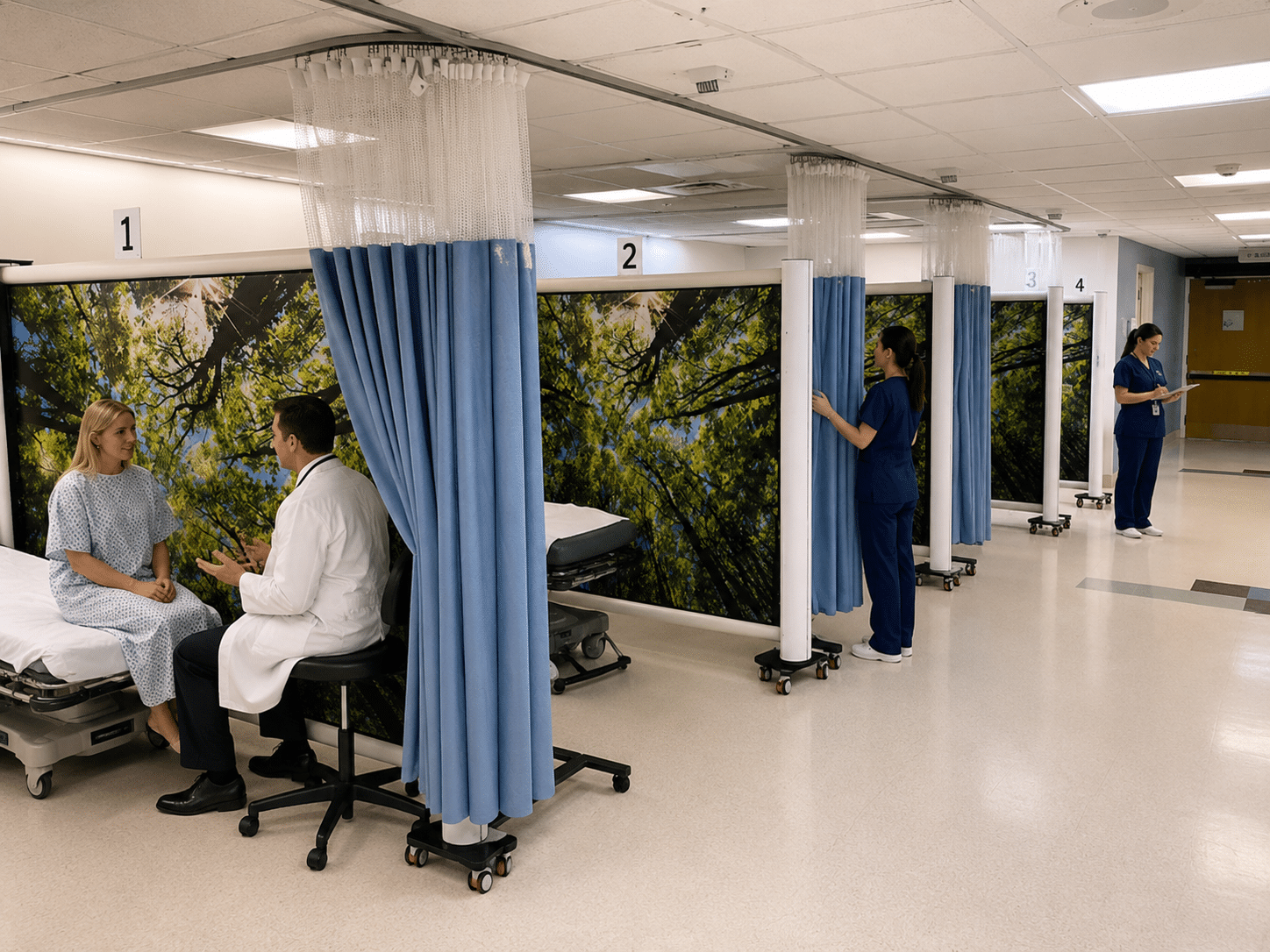
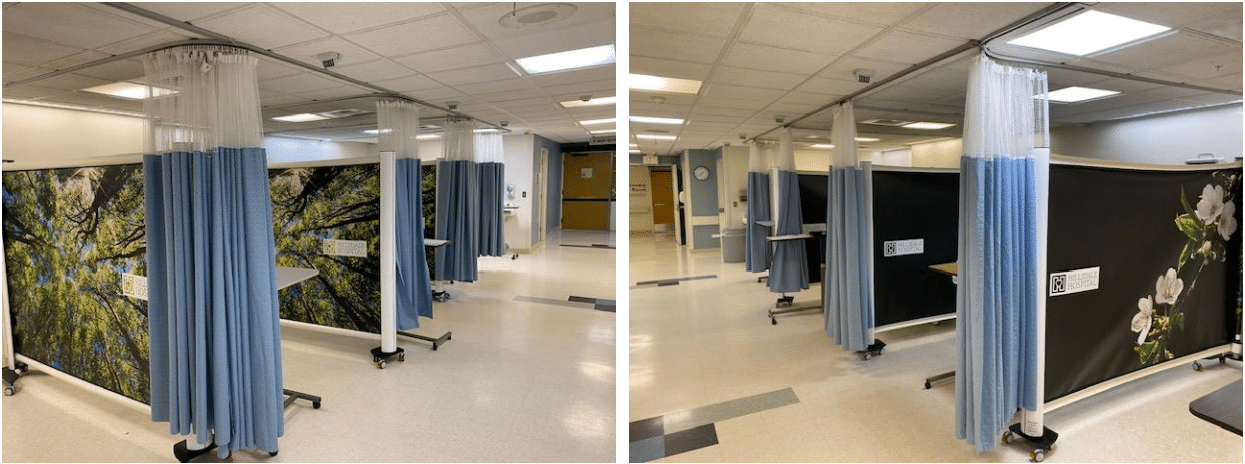
When a department temporarily relocates during renovation — a PACU moving to a converted conference room, an infusion center operating from a temporary modular unit — the new space rarely has built-in privacy infrastructure. Portable screens create the bay structure the department needs for weeks or months until the permanent space is ready.
This is also the solution for new construction commissioning delays, where a department needs to operate before its permanent home is complete.
Clinical-Grade, Not Makeshift
The traditional approach to temporary privacy is makeshift: plastic sheeting, repurposed curtains, rolling whiteboards, or borrowed office dividers. None of these meet infection control standards. None can be disinfected with bleach or quaternary ammonium compounds. None provide acoustic privacy for HIPAA-sensitive conversations.
A Rolascreen portable partition is the same clinical-grade product used in permanent ER and ICU installations — it just happens to be portable enough to serve temporary needs. Non-porous polyester film. Bleach-compatible to 10,000 ppm. Rigid acoustic barrier. Custom panel printing available. The "temporary" part is the deployment, not the quality.
What to Specify When Ordering Temporary Screens
Whether you're ordering for a single renovation phase or stocking a fleet for ongoing seasonal and event use, these are the specifications that matter.
Quantity & Bay Count
How many patient bays or stations do you need to create? Each Rolascreen unit spans up to 10'3" — one unit typically defines one side of a bay. A 12-bay overflow area might need 15–20 units depending on configuration.
Height Requirements
Standard options are 6'3" and 5'3". The taller option provides full standing-height privacy; the shorter option works for seated treatment areas like infusion chairs and phlebotomy stations while maintaining sightlines for clinical staff.
Disinfection Protocol
Confirm your facility's standard EPA-registered disinfectant. Rolascreen is validated for bleach (sodium hypochlorite up to 10,000 ppm), quaternary ammonium compounds (CaviCide), accelerated hydrogen peroxide, and alcohol-based wipes. If C. difficile is a concern, sporicidal bleach compatibility is essential.
Storage Between Deployments
Portable Elite units nest compactly. Plan for roughly 18" of depth per nested unit in a storage closet or equipment room. Multiple units fit in a single closet footprint — critical for facilities that deploy and recover screens seasonally.
Custom Panels (Optional)
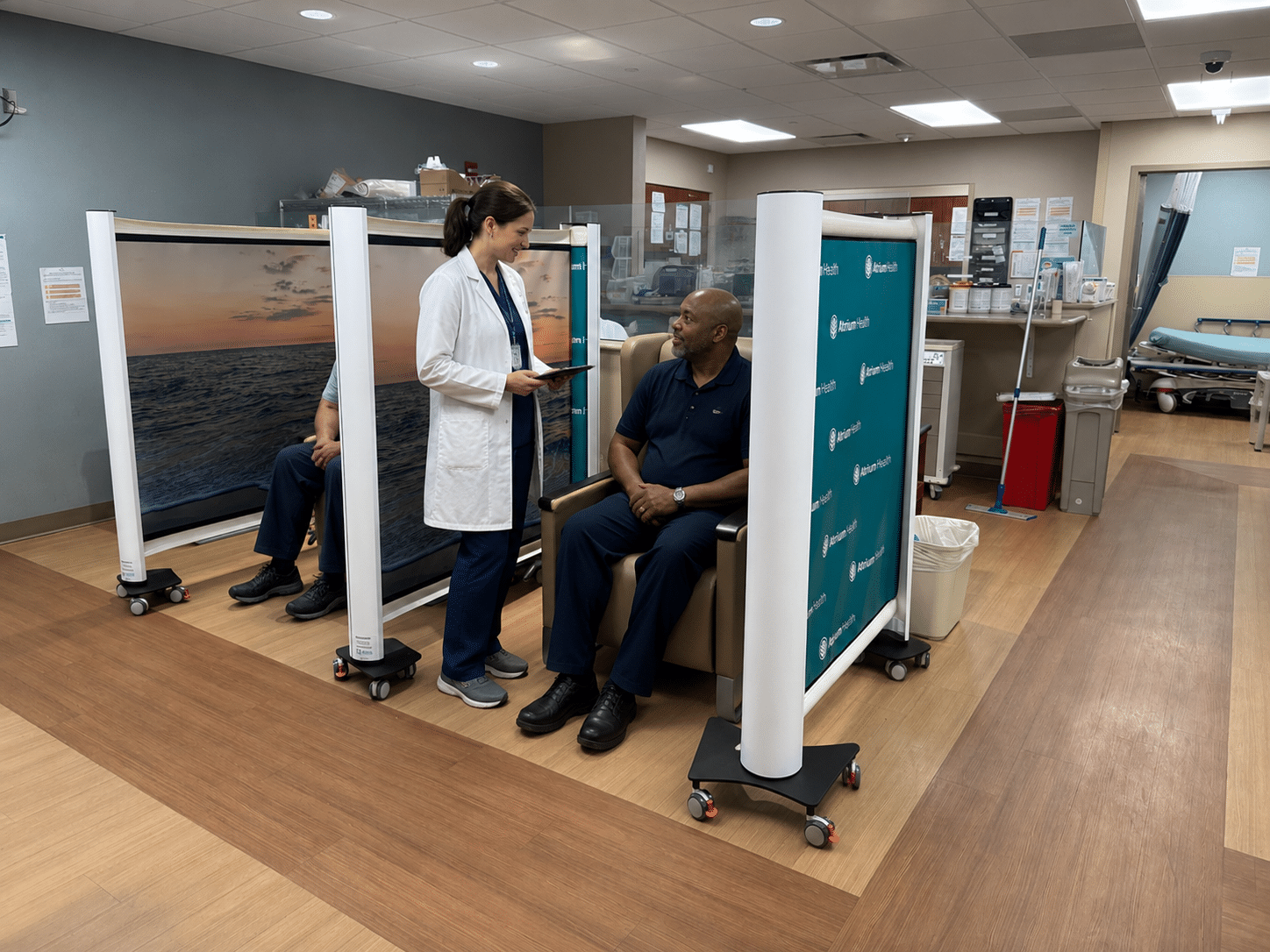
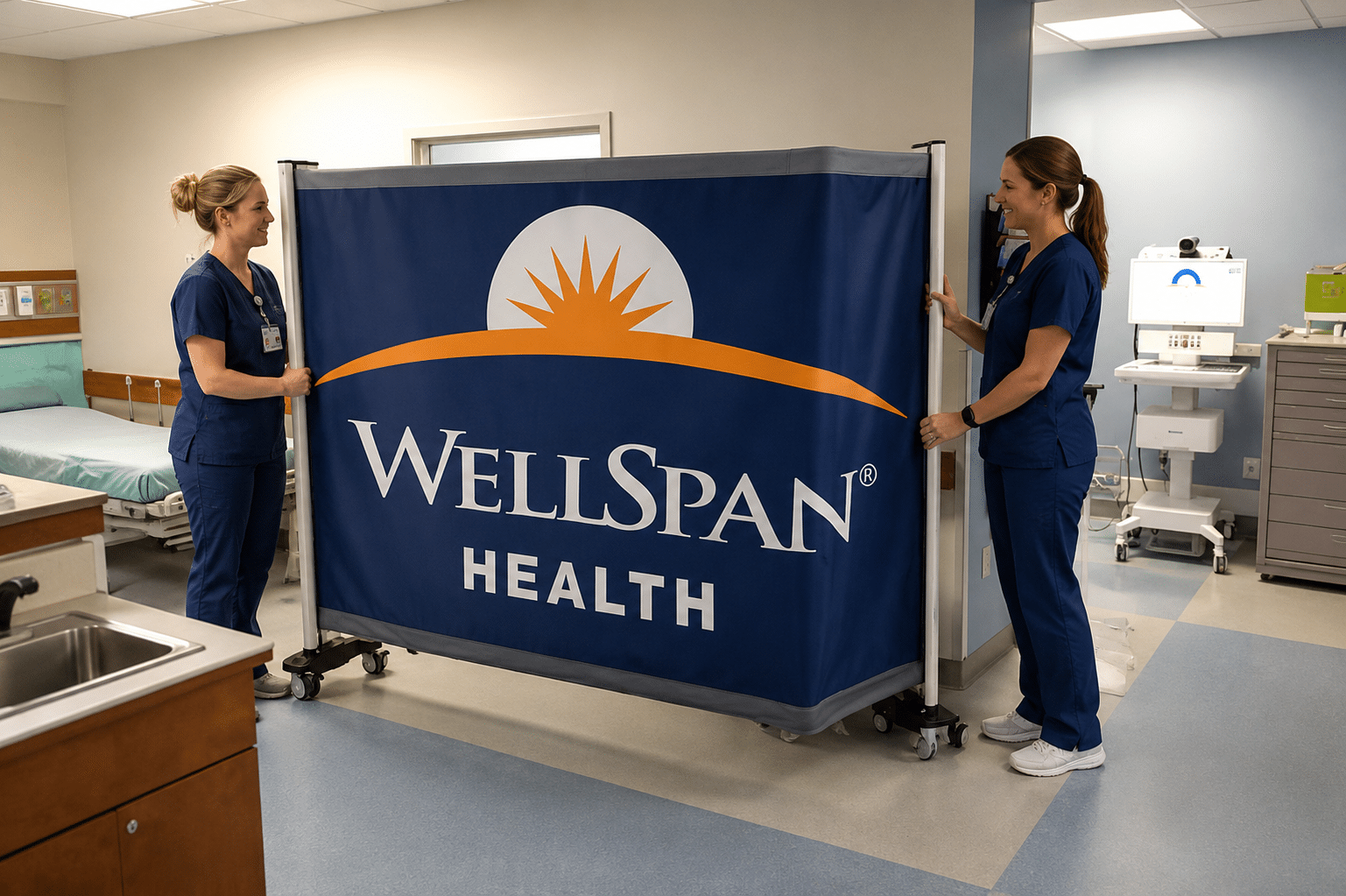
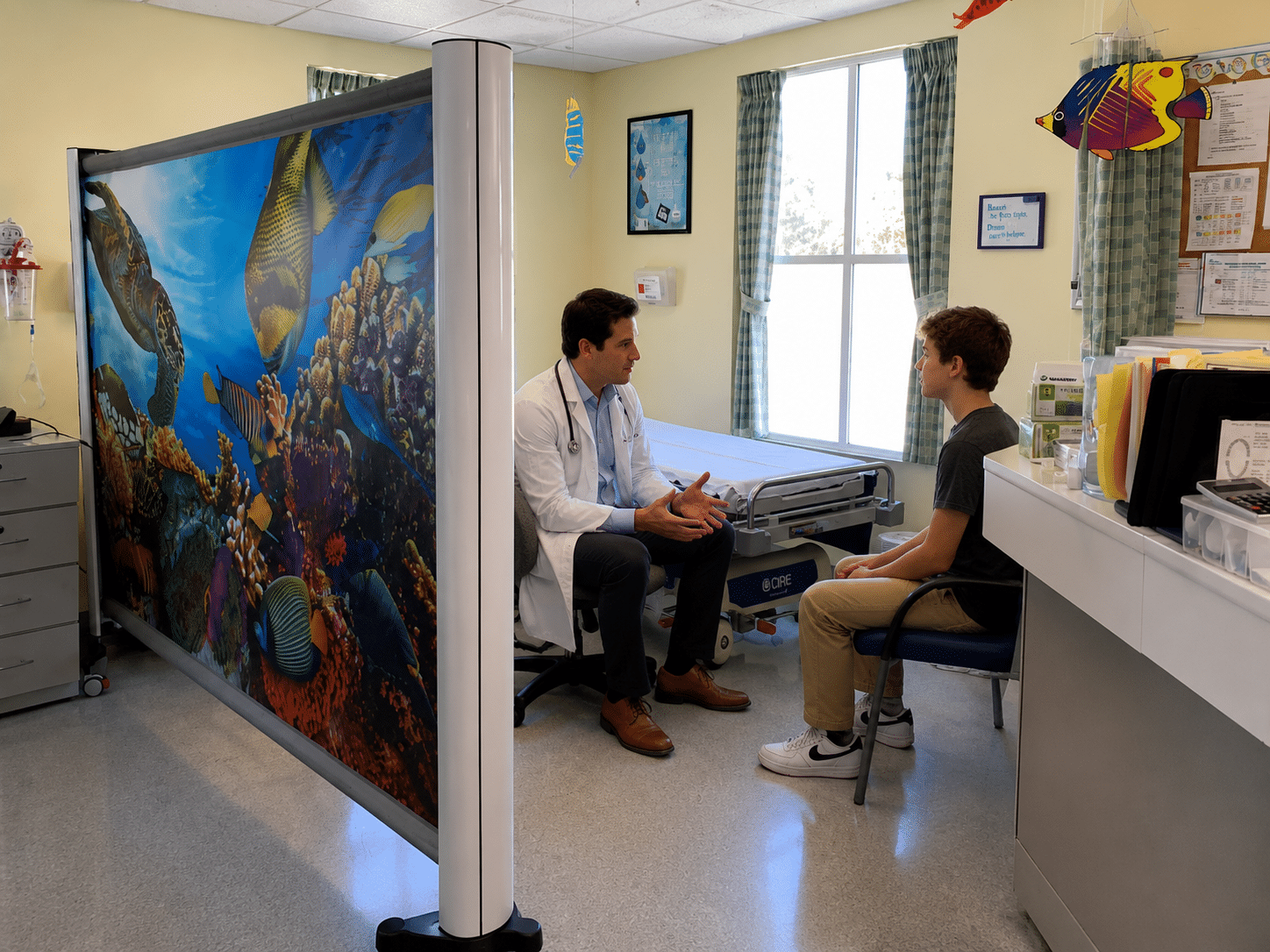
If the screens will be visible to patients and visitors, custom panel printing with calming imagery, facility branding, or wayfinding graphics transforms functional equipment into a patient-experience asset. Add your brand →
When Temporary Becomes Permanent — and That's Fine
A common pattern: a facility orders portable screens for a specific temporary need (a renovation, a flu season, an event). After the temporary need passes, staff discover the screens are useful enough to keep deployed permanently — in an infusion center, a therapy gym, or a pre-op area that never had proper privacy before. The Rolascreen Portable Elite is engineered for 10+ years of continuous clinical service, so "temporary" and "permanent" use the same product. There's no penalty for changing your mind.
Rolascreen in Temporary & Flexible Clinical Settings
Trusted by Leading Healthcare Systems


















Temporary Hospital Privacy Screens: Common Questions
Rolascreen portable partitions support the visual-separation and barrier requirements that Infection Control Risk Assessment (ICRA) protocols specify during active renovation. The non-porous surface prevents particulate accumulation and is cleanable with hospital-grade disinfectants — a standard that plastic sheeting and temporary drywall barriers do not meet. For renovation phases where patient care continues adjacent to construction zones, the screens provide a defined, cleanable boundary that can be repositioned as construction phases shift.
A single staff member can retrieve a nested Rolascreen Portable Elite from storage, wheel it into position, extend it to full 10'3" span, and lock the wheelbase in under 30 seconds per unit. A 12-bay overflow area can be fully configured in under an hour. The screens nest compactly in off-season storage — multiple units fit in a single equipment closet — so they're immediately available when census triggers overflow protocols without requiring any procurement lead time.
Yes — because the Rolascreen Portable Elite is the same product used in permanent ER and ICU installations. The non-porous polyester film panel, the disinfectant compatibility (bleach to 10,000 ppm, quats, AHP, alcohols), and the wipe-in-place cleaning protocol are identical whether the screen is deployed temporarily or permanently. The "temporary" part describes the deployment pattern, not the clinical performance of the barrier. For the full infection control specifications, see Infection Control Partitions for Hospitals.
The product is the same — the distinction is the scenario. "Temporary" typically describes planned, predictable needs: renovations, seasonal overflow, scheduled events, department relocations. "Surge" describes unplanned emergency response: pandemic outbreaks, mass casualty incidents, disaster relief. Both use the same portable Rolascreen Elite units with the same deployment, cleaning, and storage characteristics. For emergency preparedness and federal deployment specifics, see Isolation Room & Surge Capacity Partitions.
Yes — vaccination clinics, community health screenings, blood drives, and phlebotomy events are among the most common temporary deployments. The screens define individual patient stations, provide visual privacy during the encounter, and wipe clean with standard disinfectants between every patient. They're deployed the morning of the event and returned to storage the same day. Government and health department facilities have been using Rolascreen for this purpose since the COVID-19 vaccination campaigns.
Nothing changes — the Rolascreen Portable Elite is engineered for 10+ years of continuous clinical service regardless of whether the deployment was originally intended as temporary. Many facilities order screens for a specific temporary project and subsequently keep them deployed in departments that benefit from the added privacy. The product doesn't distinguish between temporary and permanent use; it simply works wherever it's positioned.
Contact our team to discuss options for your specific deployment timeline and scale. For most facilities, purchasing provides the best long-term value because the same screens serve multiple temporary projects over a 10+ year lifespan — a single purchase covers dozens of seasonal deployments, renovation phases, and event setups. Request a quote and our team will help scope the right approach for your needs.
Plan Your Temporary Deployment
Whether it's a renovation phase, a seasonal surge, or a one-day vaccination event — our team will help you scope the right quantity, height, and configuration. Quotes are no-obligation and typically returned within one business day.
Request a Quote View All Products