That scenario plays out thousands of times daily across government facilities nationwide. SSA field offices alone averaged 176,615 visitors per day in FY2023, and the VA logged more than 127.5 million health-care appointments in FY2024. Many of those interactions involve the most sensitive personal data people ever share.
The problem isn't digital. It's physical. Government buildings were often designed for throughput, not privacy — and the gap between how these spaces function and what compliance law actually requires is significant.
This post covers the regulatory drivers, the highest-need use cases, and the practical criteria government procurement teams should use when evaluating physical privacy screens.
Key Takeaways
- Physical privacy screens protect citizen data in open or shared spaces without requiring construction or renovation
- The Privacy Act of 1974 and HIPAA both create legal obligations that physical barriers directly help address
- Retractable and portable screens suit government settings well: they deploy on demand and reconfigure without tools or downtime
- Material, durability, cleanability, and procurement compliance all matter when selecting a screen for institutional use
- VA facilities, state health departments, and emergency management agencies use retractable privacy screens as a practical, field-tested solution
The Real Privacy Problem in Government Office Environments
Most government privacy conversations focus on cybersecurity — data breaches, access controls, encrypted systems. Physical exposure rarely gets the same attention, despite being a genuine and ongoing risk.
Why Physical Spaces Create Legal Exposure
Under the Privacy Act of 1974, an agency cannot disclose a protected record "by any means of communication" without consent. The Department of Justice's overview of the Privacy Act explicitly states that disclosure includes written, oral, electronic, or mechanical communication — including placing previously unknown information into another person's view.
A government employee discussing a citizen's benefits eligibility within earshot of a crowded waiting room isn't just an awkward moment. It's a potential unauthorized disclosure under federal law.
HIPAA applies the same standard to health information. HHS confirms that the HIPAA Privacy Rule protects individually identifiable health information "in any form or media, whether electronic, paper, or oral." A VA nurse confirming a diagnosis at an open check-in desk carries the same legal exposure as an unsecured digital record.
The Layout Problem
Many government facilities compound this risk through design:
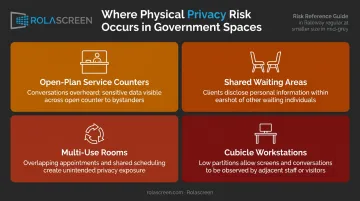
- Open-plan service counters with no separation between adjacent stations
- Shared waiting areas where citizens sit within feet of active service conversations
- Multi-use rooms repurposed daily without physical reconfiguration
- Cubicle-style workstations where case files and screens are visible to colleagues without a need-to-know
A 2022 peer-reviewed study of primary health-care environments found that building design directly affected patients' visual and auditory privacy during consultations. Government service environments face identical dynamics, with higher daily volumes and less physical separation than clinical settings.
That combination — high volume, open layout, and strict disclosure rules — is exactly where physical privacy solutions earn their place.
Regulatory and Compliance Drivers for Physical Privacy
Regulations That Apply to Government Office Spaces
Privacy Act of 1974 — the foundational federal privacy law — prohibits disclosure of system-of-records information "by any means of communication" without consent. That prohibition extends to oral and visual exposure, not just data transmission. Any government agency that maintains records about individuals is subject to this standard.
HIPAA Privacy Rule
Applies specifically to government agencies operating health-related services: VA hospitals, state health departments, public health clinics, Medicaid programs, and government-run insurance programs. HHS guidance explicitly identifies physical barriers — cubicles, dividers, shields, curtains, and similar partitions — as examples of "reasonable safeguards" to limit incidental disclosures. HIPAA does not mandate a specific design, but it does require proportionate protective measures.
E-Government Act of 2002
Section 208 requires Privacy Impact Assessments (PIAs) before agencies develop or procure technology that collects personally identifiable information. While the statute is IT-focused, PIAs increasingly lead agencies to evaluate the physical service environment, making open counter layouts and shared workspaces a natural compliance target.
State and Local Requirements
Federal statutes set the floor — state and local rules often go further. Key requirements include:
- State privacy statutes: New York's Personal Privacy Protection Law, California's Information Practices Act, and similar laws regulate how state agencies collect and disclose personal information
- ADA Title II: Shapes how public-facing service spaces must be designed; any privacy screen in a government facility cannot obstruct accessible routes or counter access per the 2010 ADA Standards
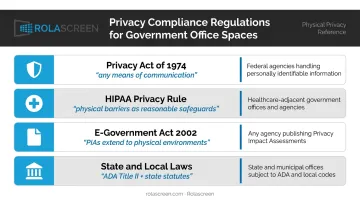
The practical takeaway: Physical privacy measures are a concrete way to demonstrate "reasonable safeguard" compliance without permanent construction. They convert a legal obligation into an operational decision.
Where Government Offices Actually Need Privacy Screens
Public-Facing Service Counters
DMVs, Social Security offices, unemployment offices, and social services departments all share the same problem: open counters built for throughput, not privacy. Citizens at these counters routinely disclose:
- Social Security numbers and financial account details
- Immigration status and case information
- Health history and benefits eligibility data
A screen or partition between adjacent service stations — or between the service counter and the public waiting area — directly reduces visual and auditory exposure. This is one of the most straightforward applications, requiring no construction and minimal footprint.
Government Health Settings
VA hospitals, state health departments, public health clinics, and government-operated behavioral health facilities face the same patient privacy challenges as private healthcare. The difference is they often lack the resources for purpose-built private rooms.
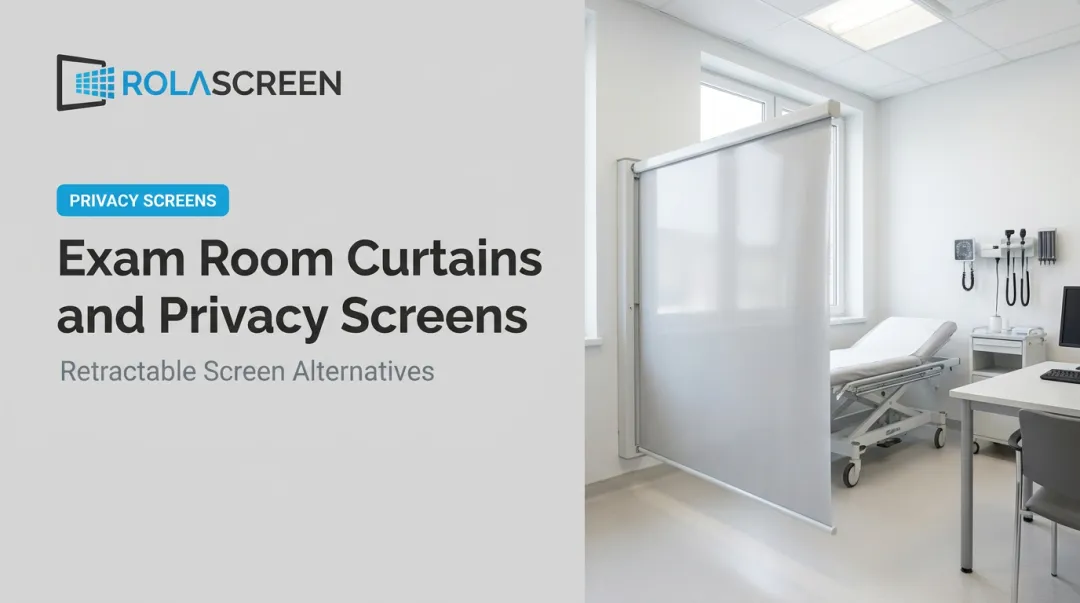
VHA Directive 1330.01(7), amended May 14, 2023, requires functional privacy curtains or screens in examination rooms serving women veterans, along with visual and auditory privacy at check-in. This is binding agency policy, not general guidance. Portable or retractable screens fill the gap between what the directive requires and what the facility's physical layout currently provides.
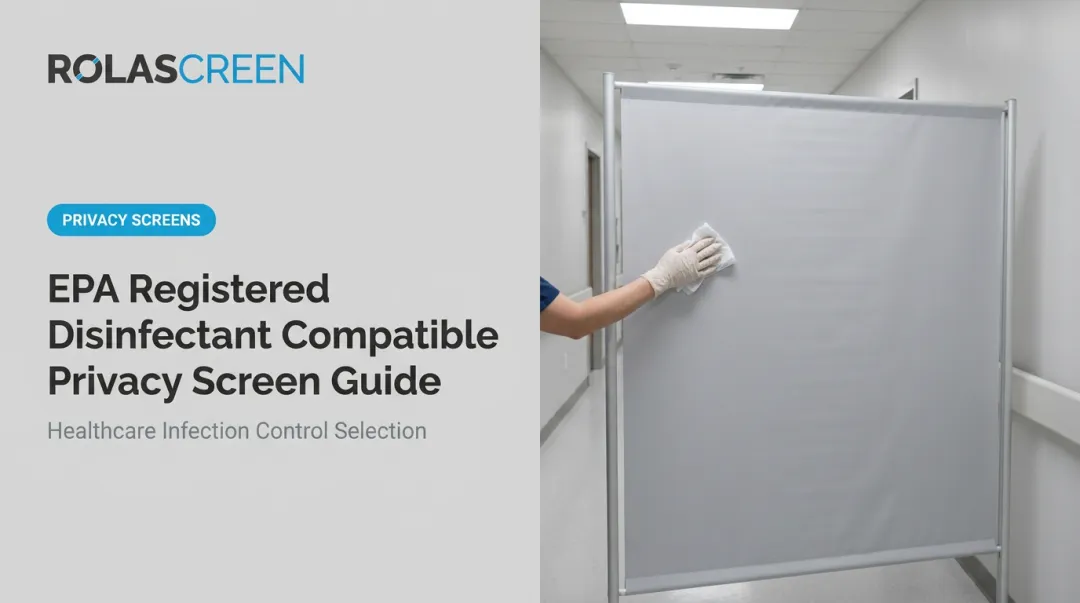
Rolascreen has supplied screens to over 200 VA and military facilities, with the non-porous, wipeable panel construction specifically suited to clinical cleaning protocols using EPA-registered disinfectants including bleach solutions and quaternary ammonium compounds.
Emergency and Disaster Response
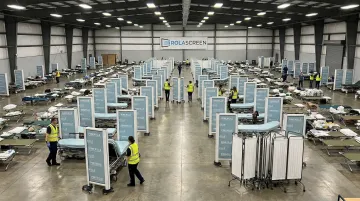
This is where portable screens prove their value most clearly. When government agencies convert gymnasiums, convention centers, or school cafeterias into emergency intake or shelter facilities, there are no walls to create private interview areas. There is only open floor space and a hard deadline.
FEMA's September 2022 Commonly Used Sheltering Items catalog includes portable "Privacy Screen/Partition" as standard shelter equipment, recognizing movable partitions as a core resource for rapid facility conversion.
Rolascreen delivered 50 Portable Elite units to the Florida Department of Health within four weeks to support hurricane disaster shelters — allowing families to be separated from others in communal spaces with no permanent infrastructure required. That deployment timeline reflects what's achievable when a domestic manufacturer with existing production capacity responds to an urgent state procurement need.
Open-Plan Government Office Environments
Privacy concerns don't stop at the public counter. Government workers in open-plan offices routinely handle sensitive materials that carry the same disclosure risk as a citizen's benefits conversation:
- Personnel files and HR records
- Security clearance documentation
- Constituent case files
- Financial records and budget data
The Privacy Act's "need to know" standard applies internally. A colleague without authorization glimpsing an open case file on a shared workstation is the same category of violation as a waiting-room bystander overhearing a sensitive intake interview.
Workstation-height screens between desks address this without reconfiguring the office layout.
Choosing the Right Privacy Screen for a Government Setting
Screen Type: Retractable vs. Portable
| Feature | Retractable/Wall-Mounted | Portable/Freestanding |
|---|---|---|
| Best for | Fixed service counters, exam rooms | Emergency deployments, multi-use rooms |
| Footprint | Minimal — mounts flush to wall | Requires floor space, moves on casters |
| Setup time | Seconds to extend/retract | Minutes to reposition |
| Reconfiguration | Limited by mount location | Full flexibility |
| Government examples | VA exam rooms, clinic check-in | Disaster shelters, temporary intake |
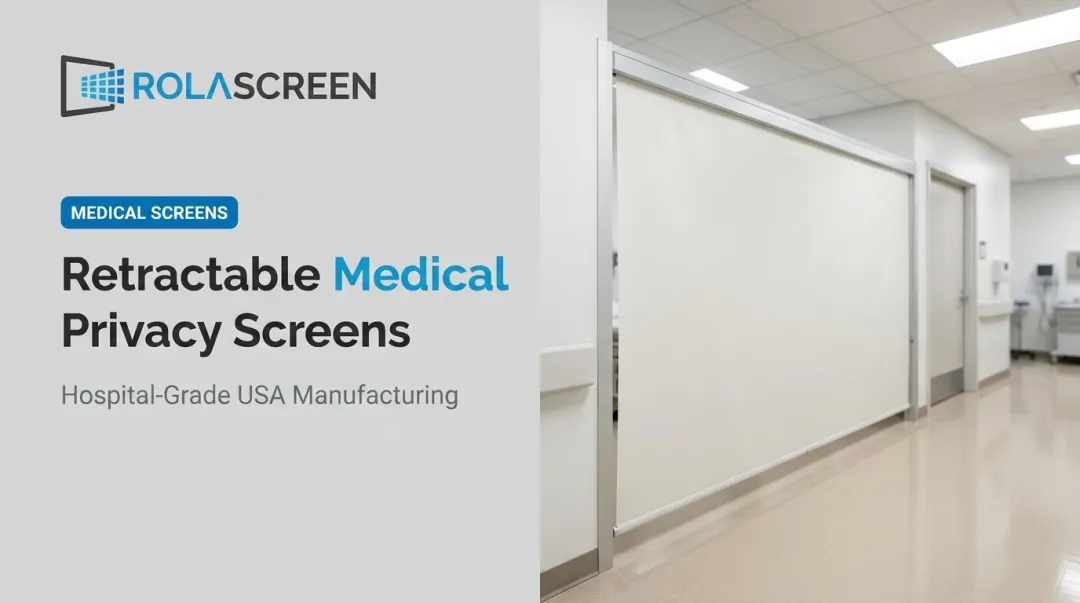
Rolascreen manufactures both types from its Chatsworth, California facility. The Wall-Mounted Elite extends up to 123 inches wide (10'3") from a flush-mount housing, while the Portable Elite moves on medical-grade casters with locking mechanisms — the same unit deployed in Florida emergency shelters.
Material Requirements for Government Health Environments
In healthcare-adjacent government settings, material selection is not cosmetic. Fabric-covered or porous screens absorb fluids and organic matter, shielding pathogens from surface disinfectants.
Rolascreen's inner panels use non-porous thermally-stabilized medical-grade polyester film (the same class used in blood glucose test strips), which can be wiped with the same disinfectants used on bedrails and IV poles without degradation.
VHA Directive 1131 requires privacy curtains to be cleaned or changed when visibly soiled and on a routine schedule. A non-porous wipeable panel integrates into that protocol without the replacement cost of fabric curtains.
Height and Coverage
Once material requirements are confirmed, coverage dimensions are the next variable. Measure the specific environment before specifying:
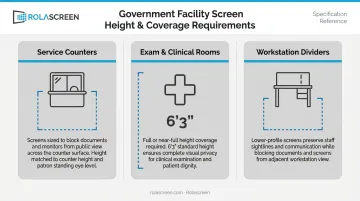
- Service counter screens need to prevent visual line-of-sight from the public side to documents and monitors
- Exam room or clinical screens may require full or near-full height (6'3" standard, custom heights available)
- Workstation dividers can use lower profiles that allow staff communication while blocking document visibility
Procurement Considerations
Height and material specs feed directly into your procurement documentation. Government buyers face additional purchasing requirements that don't apply to commercial clients:
- Domestic manufacturing: FAR sets a 65% domestic-component threshold for covered manufactured end products delivered in 2024-2028. Rolascreen manufactures in Chatsworth, California using US materials and labor — verify specific solicitation requirements with your procurement office
- GSA channels: GSA Multiple Award Schedule SIN 33721 covers office furniture including portable partitions; GSA Global Supply lists privacy and divided-space furniture by NSN
- Delivery capability: FAR 9.104-1 requires prospective contractors to demonstrate they can meet delivery schedules — a critical evaluation point for any agency with urgent deployment needs
- Urgency procurement: FAR 6.302-2 permits other-than-full-and-open competition when unusual urgency makes delay seriously injurious; document the exposure risk and substantiate the supplier's delivery capability
- Custom branding: Screens can be printed with agency logos, department branding, or public health messaging — dual-purpose products that serve both privacy and communication functions in public-facing spaces
Contact Rolascreen at 1-800-259-4214 or sales@rolascreen.com for quote documentation and to discuss government-specific procurement requirements.
Frequently Asked Questions
Is a privacy screen a physical product or a digital filter?
Physical privacy screens for government offices are tangible partitions or retractable panels — not software or digital filters. They create spatial and visual separation between people to protect sensitive conversations and documents in shared or open environments.
What regulations require privacy screens in government offices?
The Privacy Act of 1974 prohibits unauthorized disclosures by any means — including oral and visual exposure. HIPAA requires "reasonable safeguards" against incidental disclosures in government health settings, explicitly citing physical barriers as examples. State privacy laws may add further obligations depending on jurisdiction.
Which types of government offices benefit most from privacy screens?
The highest-need settings include:
- VA hospitals and government health clinics
- Social Security and benefits offices
- DMVs and social services agencies
- Emergency management operations
- Open-plan offices where staff handle PII at shared workstations
How do retractable screens differ from permanent partitions?
Retractable and portable screens can be deployed on demand, reconfigured for different room layouts, and set up in emergency or temporary facilities in minutes — without construction costs, permits, or renovation timelines. Permanent walls offer none of that flexibility.
Can privacy screens help meet HIPAA requirements in government health facilities?
Screens alone don't guarantee HIPAA compliance, but they directly address the "reasonable safeguards" requirement to limit incidental disclosures. HHS guidance specifically names dividers and shields as examples of appropriate physical controls.
How quickly can privacy screens be deployed for emergency government operations?
Portable units can be operational within hours of arrival on site. Domestic manufacturers with existing production capacity can fulfill large orders in days to weeks — Rolascreen, for example, delivered 50 units to the Florida Department of Health within four weeks for disaster shelter deployment.