Introduction
Hospital bed curtains are so common in healthcare settings that most facilities treat them as a given — fixed infrastructure rather than an active choice. But that assumption is costing facilities more than they realize, both in infection risk and operational overhead.
A 2012 study published in the American Journal of Infection Control found that 95% of monitored hospital curtains became contaminated with potentially pathogenic bacteria — including MRSA and VRE — and that 12 of 13 newly hung curtains were contaminated within a single week. Meanwhile, the CDC estimates 687,000 hospital-acquired infections (HAIs) occur annually in US acute-care hospitals, resulting in roughly 72,000 patient deaths during hospitalization.
Choosing the right privacy solution touches patient dignity, HIPAA compliance, NFPA fire safety, and infection prevention simultaneously. A poor choice doesn't just create housekeeping headaches — it creates measurable clinical and legal exposure.
This guide covers what hospital bed curtains are, why they fall short on all of these fronts, the main alternatives available today, and how to select the right solution for your facility type and budget.
Key Takeaways
- Fabric curtains rapidly accumulate drug-resistant pathogens and cannot be effectively disinfected in place between patients.
- Hard-panel screens (retractable, portable, or fixed) have non-porous surfaces wipeable with EPA-registered hospital disinfectants.
- The right choice depends on your infection control priorities, space layout, compliance requirements, and budget.
- Fabric curtains have low upfront costs but high long-term operational costs; hard-panel screens invert that equation.
- Retractable wall-mounted screens deliver the best balance of hygiene, flexibility, and lifecycle cost for most acute care settings.
What Are Hospital Bed Curtains?
Hospital bed curtains — also called cubicle curtains, privacy curtains, or nurse curtains — are fabric dividers suspended from ceiling-mounted tracks to create temporary private enclosures around patients.
Construction and Compliance
Standard curtains are built from fabric that passes flame propagation testing (per NFPA 701), with a mesh top panel and an opaque lower section. Two compliance points apply to most installations:
- Sprinkler clearance (NFPA 13): Curtains with at least 70% open mesh extending a minimum of 22 inches below the ceiling avoid obstructing sprinkler coverage.
- AHJ verification: The locally adopted NFPA edition and mesh specifications should be confirmed with the authority having jurisdiction, as requirements can vary by facility.
Some curtains include antimicrobial finishes. These reduce surface bacterial growth between cleanings but do not resolve the underlying issue: fabric is porous and cannot be fully disinfected by wiping.
Where They're Used
- Inpatient hospital rooms and semi-private bays
- Emergency departments and triage areas
- Nursing homes and long-term care facilities
- Outpatient clinics and urgent care centers
- Physical therapy spaces and school health rooms
Why Hospital Curtains Fall Short in Modern Healthcare
The Infection Control Problem
Fabric curtains cannot be disinfected in place with hospital-grade cleaners between patients. That is a structural limitation of porous fabric, not a maintenance gap.
The data on contamination rates is stark:
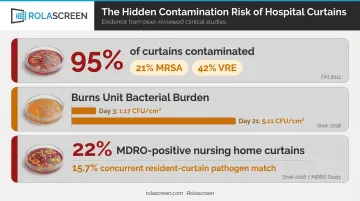
- 95% of monitored curtains became contaminated at least once in a three-week observation period, with 21% testing positive for MRSA and 42% for VRE (Ohl et al., AJIC, 2012)
- A burns unit study found MRSA-positive curtains within 14 days of hanging, with bacterial burden rising from 1.17 CFU/cm² on day 3 to 5.11 CFU/cm² by day 21 (Shek et al., AJIC, 2018)
- A University of Michigan-affiliated study of nursing home privacy curtains found 22% of samples MDRO-positive, with the same pathogen found concurrently on both resident and curtain in 15.7% of visits
The leading edge of the curtain — the part touched by staff and patients most frequently — is consistently the highest-contamination zone.
The Operational Burden
Curtain management is operationally demanding even when staff prioritize it:
- Each curtain change requires removal, transport, laundering, and reinstallation
- A 2023 military hospital study reported $3.61 per standard panel per cleaning cycle plus significant labor cost — and standard curtains were changed on a 6-month schedule or after contact precaution discharges
- Even freshly laundered curtains recontaminate within days in active care environments
Additional Limitations
Fabric curtains create friction beyond infection control as well:
- Offer no sound attenuation between patient bays
- Can be pulled from tracks accidentally during busy care episodes
- Cannot be reconfigured without reinstalling ceiling track infrastructure — a significant constraint for facilities managing renovation or shifting patient volume
Types of Hospital Privacy Screen Alternatives
Fabric curtains are no longer the only option. Today's facilities can match their privacy solution to their infection control requirements, space constraints, and operational workflow.
Traditional Fabric Curtains
Traditional fabric curtains use a ceiling-track system — fabric suspended from a fixed or curved overhead rail. They suit established inpatient rooms with existing ceiling infrastructure where budgets are tight and infection control relies on scheduled laundering.
| Strengths | Limitations |
|---|---|
| Low upfront cost per bay | Cannot be disinfected in place |
| Familiar to clinical staff | Requires removal and laundering |
| Wide range of colors/patterns | No reconfiguration flexibility |
| Meets NFPA flame test requirements | Harbors bacteria between cleanings |
Retractable Wall-Mounted Privacy Screens
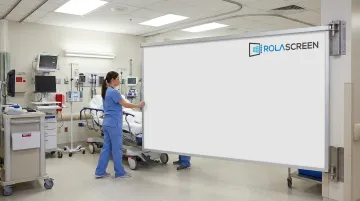
Wall-mounted retractable screens are hard-panel systems fixed to a wall or wall rail that extend on demand and retract flush when not in use. Panels are non-porous and compatible with EPA-registered hospital disinfectants — surfaces wipe clean in place between patients. No ceiling track, no removal, no laundering, no downtime.
These work best in multi-bay inpatient rooms, emergency departments, and outpatient clinics where infection control is a top priority and staff need to expand or contract privacy zones quickly. A strong fit for facilities looking to skip renovation costs.
Rolascreen — the only US-based manufacturer of retractable medical privacy screens — produces wall-mounted models (Elite and Lite) that extend to 123 inches (10'3") wide, mount flush to the wall or up to 18 inches out, and weigh 42–46 lbs depending on height. Inner panels are non-porous thermally stabilized polyester film, compatible with bleach solutions, quaternary ammonium compounds, accelerated hydrogen peroxide, CaviWipes, and CaviCide. Over 900 facilities across 47 states — including Kaiser Permanente, UCSF, UCLA, and VA facilities — rely on Rolascreen wall-mounted screens.
| Strengths | Limitations |
|---|---|
| Wipe-clean surface, no laundering needed | Higher upfront unit cost |
| Retracts flush when not in use | Requires stable wall structure |
| Customizable with branding or artwork | Coverage area set at installation |
| No recurring laundry costs | Fixed coverage width per unit |
Portable Freestanding Privacy Screens
Portable freestanding screens are self-standing panels on wheeled bases — no drilling, no ceiling track, no wall mounting required. A single staff member can reposition them in seconds.
These suit overflow areas, emergency triage, disaster shelters, vaccination sites, and temporary clinics. They also work well as supplemental privacy in large open wards.
Rolascreen's Portable Elite models extend to the same 123-inch width as the wall-mounted line, fold to approximately 6–8 inches thick for storage, and weigh 61–65 lbs with locking medical-grade casters. The Florida Department of Health received 50 portable units within four weeks for disaster shelter deployment.
| Strengths | Limitations |
|---|---|
| Zero installation required | Can be moved accidentally by patients/equipment |
| Repositioned in seconds | Requires floor space for base |
| Deployable across departments | Cleaning protocols must be consistently enforced |
| Compact storage when not in use |
Fixed Panel Dividers and Smart Glass
Fixed panel dividers — drywall, polycarbonate, or electronically switchable smart glass — create permanent privacy zones. They suit new construction or major renovations where patient bay layouts are unlikely to change. Smart glass works in high-acuity or specialty environments where instant opacity switching is clinically useful.
The trade-off is cost and inflexibility. Smart glass requires electrical infrastructure, controls, and ongoing maintenance. One vendor quotes switchable glass at $80–$140 per square foot, before framing, wiring, commissioning, or healthcare construction compliance costs. For facilities with changing patient volumes or evolving space needs, the other three options in this list are worth evaluating first.
How to Choose the Right Privacy Solution for Your Facility
The right choice is not about which option is most advanced. It is about which solution fits your actual workflow, space, and compliance requirements.
Infection Control Priority
If HAI prevention is a primary concern — and in most acute care settings it should be — prioritize non-porous, wipe-clean surfaces that can be disinfected in place between every patient. The CDC reports an estimated 687,000 HAIs in US acute-care hospitals annually, with about 72,000 patient deaths during hospitalization among affected patients.
Standard fabric curtains cannot meet this standard. Any facility managing contact precautions, isolation protocols, or high patient turnover should treat non-porous hard-panel screens as the baseline, not a premium upgrade.
Space and Configuration
Ask three questions before selecting a product type:
- Does your space have existing ceiling track infrastructure?
- Are your walls suitable for mounting (drywall with studs, concrete, etc.)?
- Does your layout change frequently, or is it consistent?
Retractable wall-mounted screens work well in rooms with stable, predictable layouts. Portable screens are the right call for flexible or temporary spaces where permanent installation is impractical.
Compliance Requirements
Confirm that any solution meets:
- NFPA fire safety requirements — verify material flame propagation testing per NFPA 701 and sprinkler coordination per NFPA 13 with your AHJ
- HIPAA visual privacy standards — HHS guidance confirms that curtains, dividers, and screens may all constitute reasonable safeguards; the requirement is adequate visual coverage in actual workflows, not a specific product
- CMS patient rights — 42 CFR 482.13(c)(1) establishes the right to personal privacy during examinations, treatment, and hygiene; evaluate coverage against real clinical scenarios
- Disinfectant compatibility — confirm the panel material is compatible with the specific EPA-registered disinfectants your facility already uses (bleach, quats, accelerated hydrogen peroxide)
Once compliance is confirmed, the financial case becomes straightforward.
Long-Term Cost vs. Upfront Investment
The total cost of ownership comparison consistently favors hard-panel screens for facilities with high patient turnover. Key cost drivers to evaluate:
- Fabric curtain laundering costs range from $50–$200 per cleaning cycle, recurring throughout the year
- Track installation alone can run $1,500–$2,500 per curtain system before any recurring expenses
- Fabric curtain replacement frequency of every 3–6 months multiplies total spend significantly
- Rolascreen units are built for 10+ years of service with zero laundering costs — wipe-down integrates into standard EVS terminal cleaning in approximately two minutes
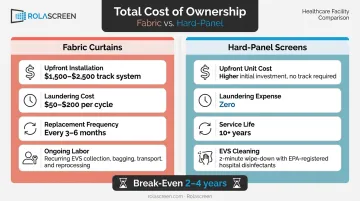
Break-even on operational costs typically lands at two to four years for facilities with active laundering contracts — and that calculation does not yet account for the cost of a single prevented HAI.
Customization and Environment
Privacy solutions do not have to be purely functional. Screens with calming artwork, facility branding, or color-coordinated panels improve patient experience and reduce anxiety. Rolascreen's interchangeable panel system lets facilities update graphics without replacing frames — useful when organizational branding changes or screens move between departments.
Mary Bridge Children's MultiCare deployed custom screens featuring marine-themed illustrations in their pediatric setting. Santa Rosa Memorial's Emergency Department reported staff and patients both responded favorably to the imagery, with the lead nurse noting the screens were "nothing like the flimsy curtains and screens we used in the past."
What to Check Before Finalizing Your Choice
Don't over-engineer. Smart glass and fixed panels make sense for new construction. For most existing facilities, a retractable or portable screen meets the same clinical needs at a fraction of the cost and installation effort.
Verify disinfectant compatibility. Ask the manufacturer which EPA-registered disinfectants (bleach, quats, accelerated H2O2) are compatible with the panel surface — and get it in writing. Fabric curtains marketed as "antimicrobial" are not the same as solid-surface panels you can fully wipe down between patients.
Account for future flexibility. Healthcare facilities reconfigure regularly, and fixed installations don't move with you. Portable units reposition in seconds; wall-mounted retractable screens can be relocated with professional reinstallation. If your layout is uncertain, a hybrid approach works well: wall-mounted screens in high-use fixed areas, portable units for everything else.
Frequently Asked Questions
What are hospital bed curtains called?
Hospital bed curtains go by several names: cubicle curtains, privacy curtains, or nurse curtains. All refer to the fabric dividers suspended from ceiling-mounted tracks used to create patient privacy enclosures in clinical settings.
What is the purpose of hospital curtains?
Hospital curtains create a visual privacy barrier around patients during examinations, procedures, and personal care. They support patient dignity, help maintain HIPAA visual privacy standards in multi-patient areas, and allow clinical staff to work without exposing adjacent patients.
Are hospital curtains a source of hospital-acquired infections?
Yes. Multiple peer-reviewed studies have found drug-resistant pathogens including MRSA, VRE, and C. difficile on hospital curtain surfaces. Fabric curtains are considered a significant environmental contamination risk because they cannot be effectively disinfected in place and recontaminate rapidly in active care environments.
How often should hospital curtains be replaced or laundered?
CDC guidance calls for laundering when visibly soiled, after confirmed contamination, after isolation discharge, and on a regular facility-defined schedule — though no universal interval applies across all settings. Even freshly laundered curtains recontaminate quickly: one study found 12 of 13 newly hung curtains contaminated within one week.
What is the best alternative to hospital privacy curtains for infection control?
Retractable hard-panel screens with non-porous, wipe-clean surfaces are widely considered the most practical alternative. They can be disinfected in place between patients using standard hospital-grade cleaners — no removal or laundering required.
Can privacy screens meet NFPA and HIPAA compliance requirements?
Hard-panel privacy screens can meet both NFPA fire safety requirements and HIPAA visual privacy standards. Buyers should request material certification documentation from the manufacturer and verify panel height coverage against actual patient care workflows to confirm compliance with both federal and facility-specific requirements.