Hospital privacy screens exist to resolve that tension without tearing down walls. They're physical barriers — rigid or semi-rigid panels in retractable, portable, or fixed configurations — designed specifically for clinical environments. This article covers what they are, why hospitals rely on them, how they support infection control, the main types available, and what procurement teams should evaluate before buying.
Key Takeaways
- Hospital privacy screens create visual separation in shared spaces, protecting patient dignity and confidentiality during examinations and consultations
- Non-porous, wipeable surfaces are far more hygienic than fabric curtains, which harbor MRSA and other pathogens
- HIPAA's Privacy Rule (45 CFR 164.530) requires limiting incidental PHI disclosures; privacy screens directly support that requirement
- Retractable, portable, and fixed panel options each suit different clinical workflows and space requirements
- Top purchasing criteria: surface cleanability, mobility, and NFPA 101 fire safety compliance
What Is a Privacy Screen in a Hospital?
A hospital privacy screen is a freestanding or wall-mounted barrier that creates visual separation between patients, clinical areas, or staff workspaces. Clinical environments demand specific material properties, regulatory awareness, and infection control compatibility — requirements that general-purpose room dividers simply aren't built to meet.
Note: In healthcare IT, "privacy screen" sometimes refers to monitor anti-glare filters. This article covers physical spatial dividers used in patient care areas.
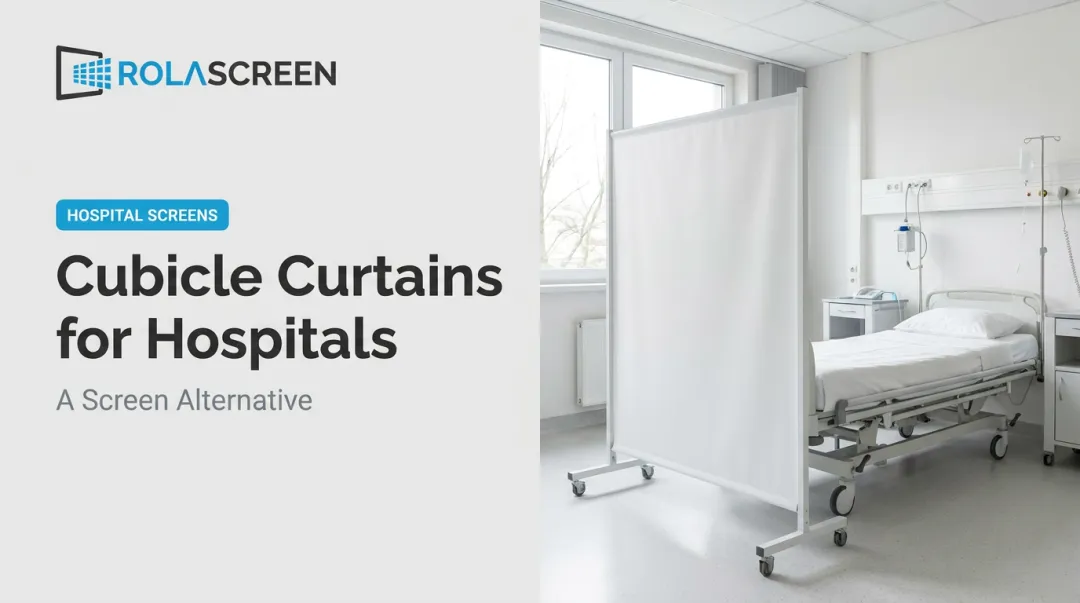
How Screens Differ from Traditional Curtains
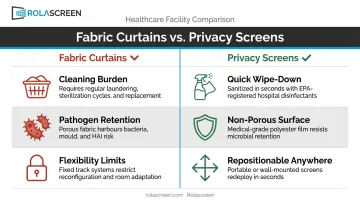
Most people picture fabric curtains hanging from ceiling tracks when they think of hospital privacy barriers. Those curtains have been the standard for decades — but they come with well-documented problems:
- Cleaning burden: Fabric curtains require laundering, which typically happens every few weeks at best, or when visibly soiled
- Pathogen retention: Porous textile fibers trap bacteria and viruses deep in the weave where disinfectants can't reach
- Flexibility limits: Ceiling-track systems are fixed to their installation path and can't be repositioned
Modern privacy screens address each of these gaps. Rigid or semi-rigid panels in retractable or portable formats can be repositioned on demand, and their non-porous surfaces wipe down between patients in minutes with standard hospital disinfectants.
Where They're Deployed
Privacy screens appear across every department where shared spaces and patient care intersect:
- Multi-bed inpatient wards
- Emergency department triage bays
- Post-procedure recovery areas
- Vaccination and testing sites
- Open waiting areas converted for clinical use
- Staff consultation zones within open floor plans
Why Hospitals Use Privacy Screens
Patient Dignity and Satisfaction
Patients undergoing examinations, procedures, or clinical conversations have a fundamental right to privacy — and when that right feels compromised, it affects care quality in measurable ways. A 2023 retrospective study of 10,703 inpatients at Stanford Health Care found that patients in private rooms had an 86% HCAHPS top-box likelihood-to-recommend score versus 79% for semi-private rooms (adjusted odds ratio 1.32). Though the study examined room type rather than portable screens, it establishes a clear link between perceived privacy and patient satisfaction.
Beyond satisfaction scores, privacy directly affects clinical honesty. Patients in open or semi-open spaces are less likely to disclose sensitive information — which compromises the quality of the clinical encounter itself.
HIPAA Compliance
HIPAA's Privacy Rule under 45 CFR 164.530(c) requires covered entities to maintain appropriate physical safeguards and take reasonable steps to limit incidental disclosures of protected health information (PHI). HHS guidance specifically cites cubicles, dividers, shields, and curtains as appropriate safeguards in shared care environments.
Privacy screens don't satisfy a specific product mandate — HIPAA doesn't require a particular barrier type. But they're a direct, practical implementation of what the rule describes: a physical measure that limits who can see or overhear a clinical interaction. That same need to limit exposure — without rebuilding every room — is what makes operational flexibility equally important.
Space Flexibility Without Construction
Renovation is costly and disruptive. Privacy screens let hospitals reconfigure open areas on demand — converting a waiting room into triage bays during a patient surge, or partitioning a gymnasium into a vaccination clinic — without a single contractor.
During COVID-19, this flexibility proved critical. The U.S. Army's 250-bed field hospital at Seattle's CenturyLink Event Center installed barriers between beds specifically to address civilian privacy expectations — a documented example of portable separation infrastructure functioning at scale in an alternate care setting.
Rolascreen supplied over 200 screens to VA and military facilities during the pandemic, including vaccine station setups, ward separation, and alternate care site conversions. Staff at Wilmington VA Medical Center described the screens as a "game changer" for setting up vaccination stations throughout the facility.
Staff and Operational Efficiency
Privacy screens also define staff zones, creating functional boundaries within open floor plans without the cost or permanence of drywall. Common applications include:
- Consultation areas separated from general foot traffic
- Administrative workstations shielded from patient-facing zones
- Clinical team huddle spaces partitioned within open units
- Temporary triage or intake stations during high-census periods
Each of these setups can be assembled, repositioned, or removed in minutes — giving facilities the kind of day-to-day adaptability that permanent construction simply can't offer.
The Role of Privacy Screens in Infection Control
The Problem with Fabric Curtains
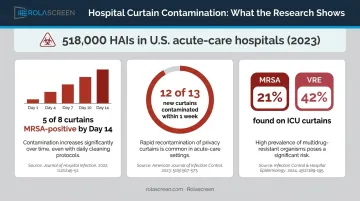
The CDC reports an estimated 518,000 HAIs in U.S. acute-care hospitals in 2023, with a 2.6% point prevalence across 218 acute-care facilities. Fabric privacy curtains are a documented contributor to pathogen circulation.
The research is specific:
- A 2018 study found MRSA on 5 of 8 curtains by day 14, with mean bacterial burden rising from 1.17 CFU/cm² on day 3 to 5.11 CFU/cm² by day 21
- A 2012 study of 43 curtains across two ICUs and one medical ward found that 12 of 13 newly placed curtains were contaminated within one week, with 21% yielding MRSA and 42% VRE
- A 2023 military hospital study found standard cloth curtains accumulated substantially greater bacterial burden over 20 weeks compared to antimicrobial alternatives — with standard curtains changed only every 6 months under routine protocol
The core problem is structural: porous textile fibers create microenvironments that disinfectants can't penetrate. Pathogens colonize deep in the weave and survive laundering cycles.
Why Non-Porous Surfaces Perform Better
Non-porous panel surfaces don't eliminate pathogen persistence — some organisms actually persist longer on smooth surfaces than on fabric. The clinical advantage is cleanability: a smooth, sealed surface gives disinfectants full, unobstructed contact with any pathogens during a wipe-down.
Rolascreen's panels use thermally-stabilized medical-grade polyester film — the same material category used in blood glucose test strips — with zero porosity, no fiber matrix for microbial entrapment, and moisture barrier properties that prevent fluid absorption.
The panels are compatible with all major hospital-grade disinfectants:
- Bleach up to 10,000 ppm
- Quaternary ammonium compounds
- Accelerated hydrogen peroxide
- Alcohol-based wipes
Practical Cleaning Protocol
Because the surface is sealed and smooth, environmental services staff can disinfect a screen panel in the same pass as bedrails and IV poles — under two minutes per partition, with no removal or reinstallation required. Compare that to fabric curtains, which must be unclipped, sent to laundry, and rehung — a process that happens every few weeks at best.
That cleaning efficiency also extends to outbreak response. During high-transmission periods, portable screens function as physical droplet barriers between patients in shared areas. CDC droplet precaution guidance emphasizes spatial separation and curtain use between beds in multi-bed rooms — a role non-porous screens fulfill while adding the cleanability advantage fabric cannot match.
Types of Hospital Privacy Screens
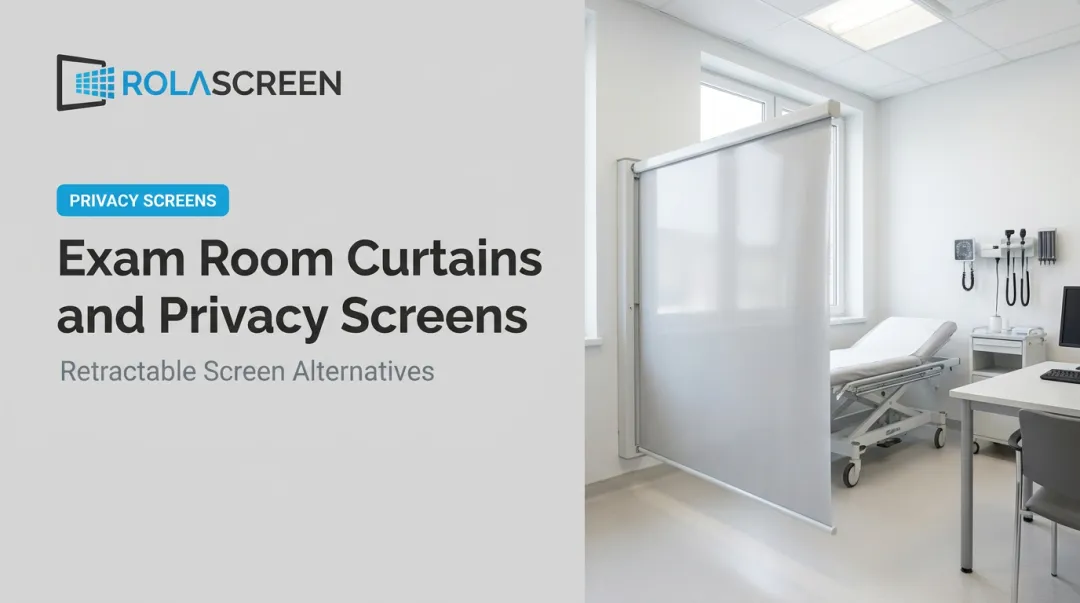
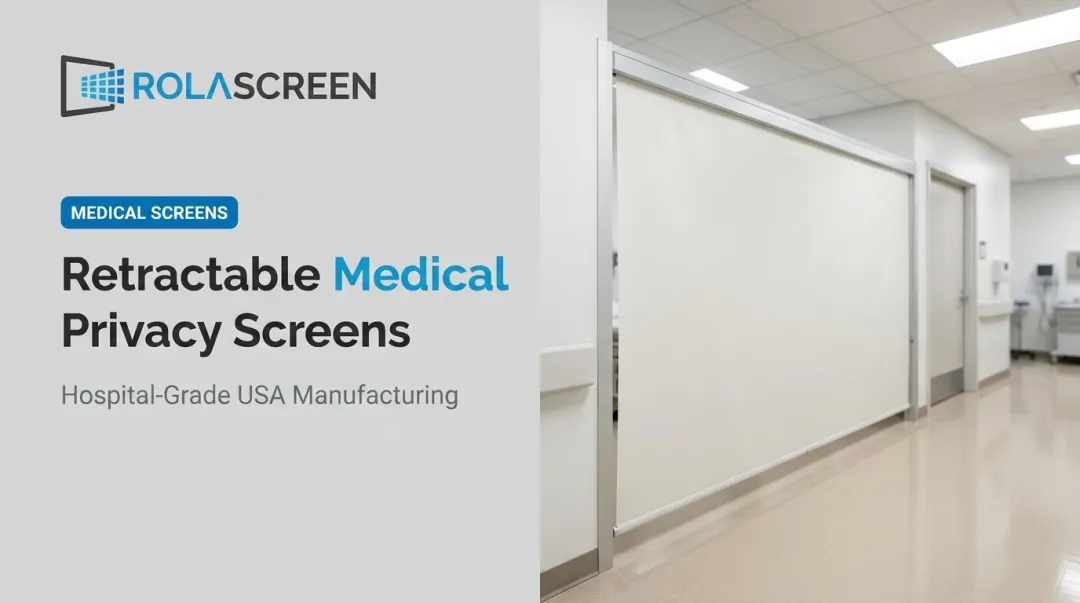
Retractable Privacy Screens
Wall- or ceiling-mounted units with a roll-out panel that extends when needed and retracts to free up space when not in use. Key advantages:
- Zero floor footprint when retracted — critical in tight clinical spaces
- Instant deployment without repositioning the unit
- Permanent installation in fixed patient bays or exam rooms
Rolascreen's wall-mounted models — the Elite and Lite — mount either flush to the wall or up to 18 inches from it (allowing clearance for IV poles and equipment). Both extend to 123 inches (10'3") wide and are available in standard heights of 6'3" or 5'3", with custom heights available.
Portable and Freestanding Privacy Screens
Wheeled or lightweight freestanding units that can be moved anywhere in a facility without tools or installation. Best suited for:
- Emergency surge scenarios where space configuration changes rapidly
- Departments where privacy needs shift throughout the day
- Non-clinical spaces converted for temporary patient care (gyms, cafeterias, conference rooms)
- Facilities where wall mounting isn't feasible
Rolascreen's Portable Elite model weighs 65 lbs (6'3") or 61 lbs (5'3") and extends to the same 123-inch width as the wall-mounted line. The Santa Rosa Memorial Hospital emergency department used portable Rolascreen units for hallway beds and improvised care areas during surge conditions following the 2017–2018 California wildfires.
Fixed Panel Dividers
Where retractable and portable screens offer flexibility, fixed panel dividers take a different approach: semi-permanent partitions that create dedicated zones within open-plan clinical areas. They're the right choice when a layout rarely changes and consistent zone separation matters more than reconfigurability.
Common applications include:
- Fixed dialysis and infusion bays with assigned patient stations
- Established consultation zones in outpatient clinics
- Rehab and physical therapy areas with defined treatment lanes
Rolascreen can configure fixed-panel solutions to match specific bay widths, heights, and branding requirements — including custom-printed panels for wayfinding or patient-facing messaging.
Quick Comparison: Which Screen Type Fits Your Setting?
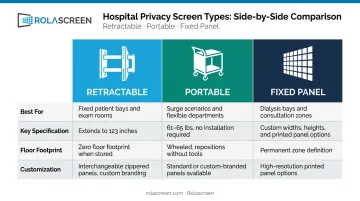
| Screen Type | Best For | Key Spec |
|---|---|---|
| Retractable (Wall-Mounted) | Fixed patient bays, exam rooms, ED triage | Extends to 123"; zero floor footprint when stored |
| Portable (Freestanding) | Surge scenarios, flexible departments, temporary care spaces | 61–65 lbs; no installation required |
| Fixed Panel Dividers | Dialysis bays, established consultation zones | Custom widths, heights, and printed panel options |
What to Look for in a Hospital Privacy Screen
Not every screen marketed for healthcare actually belongs in a clinical environment. These four criteria separate appropriate products from costly mistakes:
Surface Material and Cleanability
- Must be non-porous, smooth, and rated for repeated use with hospital-grade disinfectants
- Porous or fabric-based screens are inappropriate for clinical use regardless of price
- Confirm compatibility with the specific chemistries your facility uses (bleach, quats, AHP)
Mobility and Deployment Ease
- Portable screens should be lightweight with stable, lockable bases
- Retractable screens should extend and retract smoothly without tools
- How often the screen gets repositioned determines whether portable or wall-mounted is the right fit for your unit
Fire safety compliance is equally non-negotiable and deserves careful verification before procurement.
Compliance with healthcare fire safety standards
- CMS applies NFPA 101-2012 and NFPA 99-2012 to hospital physical environments under 42 CFR 482.41
- Panel materials should meet applicable flame-spread and smoke-developed index requirements (tested under UL 723 / ASTM E84)
- Verify product-specific compliance documentation before procurement — no universal healthcare-screen UL category exists, so product-level verification matters
Customization options
- Custom-printed panels support patient-calming imagery, facility branding, and wayfinding
- Atrium Health has deployed Rolascreen panels with both organizational branding and calming nature imagery in clinical settings
- Custom-branded screens typically require 3–6 weeks from artwork approval; standard non-printed screens ship in 10–30 days
Frequently Asked Questions
What is a privacy screen used for in a hospital?
Hospital privacy screens create visual separation between patients in shared spaces, protect dignity during examinations and consultations, and support HIPAA compliance by limiting incidental PHI disclosures. Non-porous versions also reduce infection risk by replacing fabric curtains that harbor pathogens.
How is a hospital privacy screen different from a privacy curtain?
Fabric privacy curtains hang from ceiling tracks, are difficult to clean thoroughly, and are documented reservoirs for MRSA and VRE. Rigid or semi-rigid privacy screens have non-porous surfaces that can be wiped down with hospital-grade disinfectants between patients — making them more hygienic and operationally flexible.
Is there a privacy screen you can turn on and off?
Retractable privacy screens work similarly — the panel extends fully when privacy is needed and rolls back into a compact housing when not in use. This makes them a practical on/off solution for fixed patient bays and exam rooms without consuming permanent floor space.
Do hospitals have to provide patient privacy under HIPAA?
HIPAA's Privacy Rule (45 CFR 164.530) requires covered entities to implement physical safeguards limiting incidental PHI disclosures. HHS guidance specifically cites physical barriers — dividers and curtains — as appropriate measures in shared clinical spaces.
How often should hospital privacy screens be cleaned?
Non-porous privacy screens should be wiped down with an approved hospital-grade disinfectant between each patient, following the facility's standard surface disinfection protocol — the same pass used for bedrails and overbed tables. This is far more frequent than fabric curtains, which are typically laundered every several weeks.
Can privacy screens help reduce hospital-acquired infections?
Replacing porous fabric curtains — known carriers of MRSA, VRE, and other pathogens — with wipeable, non-porous screens removes one documented pathway for transmission. Because disinfectants make full contact with the surface, thorough between-patient cleaning is fast, consistent, and verifiable.