Introduction
Healthcare facilities face a persistent tension: maintaining patient dignity while keeping clinical spaces flexible and infection-controlled. Traditional fabric curtains have long been the default solution — but that default is increasingly hard to defend.
Research published in PubMed found that 95% of 43 hospital privacy curtains tested were contaminated with potentially pathogenic bacteria, including MRSA and VRE. That's not an edge case — that's the norm in active clinical environments.
Patient privacy also carries regulatory weight. Under 45 CFR 164.530(c), HIPAA requires physical safeguards to protect patient information, and HHS explicitly recognizes barriers and dividers as reasonable safeguards in multi-patient areas.
Navigating both infection risk and compliance requirements is what makes choosing the right privacy solution consequential. This guide covers what procurement teams, facility managers, and infection preventionists need to know: what retractable medical privacy screens are, how they outperform curtains, which settings benefit most, and what to evaluate before purchasing.
Rolascreen, the only U.S.-based manufacturer of retractable medical privacy screens, serves as a reference example throughout. Their products are deployed in 900+ healthcare facilities across 47 states.
Key Takeaways
- Fabric curtains carry MRSA and VRE within days of laundering — non-porous retractable screens wipe clean between every patient encounter
- HHS confirms barriers and dividers qualify as HIPAA privacy safeguards under 45 CFR 164.530(c)
- Retractable screens deploy in seconds — no construction permits, wall modifications, or facility downtime required
- Wall-mounted and portable configurations are available, with flexible bending to wrap around beds or equipment
- USA-manufactured screens meet Buy American Act requirements for VA and federal government facilities
Why Traditional Hospital Curtains Are a Hidden Infection Risk
Fabric privacy curtains are among the most frequently touched surfaces in any clinical setting. Staff pull them during rounds. Patients grab them for privacy. Visitors brush against them constantly. Each contact transfers bacteria — and the fabric holds it.
What the Research Shows
The contamination data is stark:
- 95% of curtains tested harbored pathogenic bacteria, with 21% positive for MRSA and 42% for VRE, according to a study of 43 curtains across two ICUs and one medical ward
- Of 13 curtains newly installed during the same study, 12 were contaminated within one week
- A separate pilot study tracked 10 freshly laundered curtains: bacterial burden rose from 1.17 CFU/cm² on day 3 to 5.11 CFU/cm² by day 21, with 62.5% testing MRSA-positive by day 14
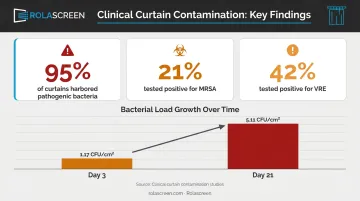
Laundering doesn't solve the problem — it only delays recontamination by days.
The Laundering Problem
The operational burden of curtain management compounds the infection risk:
- Curtains must be physically removed, sent offsite for laundering, and rehung — a process requiring significant labor hours
- During the cleaning cycle, the patient bay has no privacy barrier
- One facility study estimated curtain-related labor and cost savings of $20,079 annually by switching to an alternative product — and that was comparing one fabric curtain type to another, not to a hard-surface screen
The Core Problem Is the Material
Those cost savings matter — but they don't fix the underlying problem. Laundering schedules and antimicrobial fabric treatments can only do so much when the material itself works against you. Porous fabric inherently traps pathogens in its fibers, and no cleaning protocol fully overcomes that structural reality.
Infection prevention guidance from the Association for the Healthcare Environment reflects this directly: smooth, nonporous surfaces with minimized seams and joints are recommended for all healthcare furniture and equipment. Retractable screens with non-porous, wipe-clean panels — wipeable with EPA-registered disinfectants including bleach, quats, and accelerated hydrogen peroxide — eliminate the fiber-trapping problem at the source rather than working around it.
What Are Retractable Medical Privacy Screens?
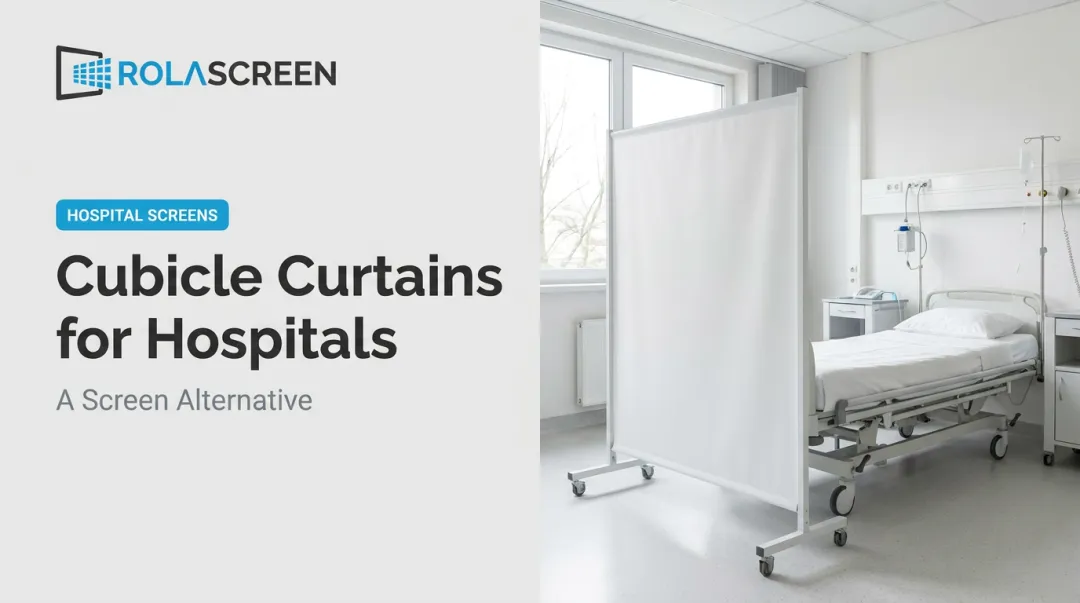
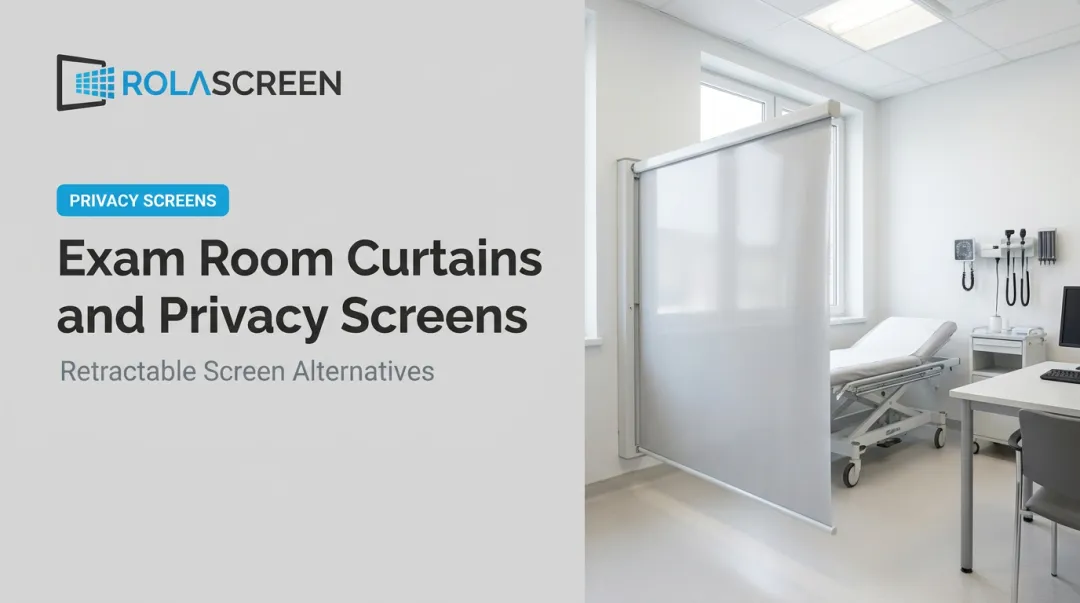
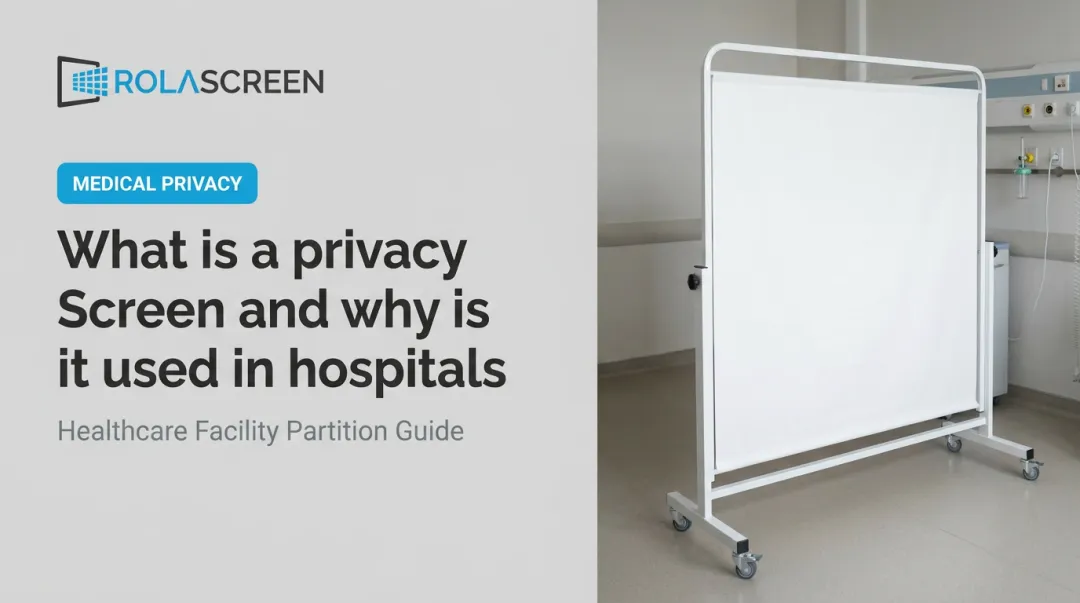
Retractable medical privacy screens are rigid or semi-rigid panels that extend from a housing unit — wall-mounted, ceiling-track, or freestanding wheeled base — to create instant visual barriers in clinical spaces. When not needed, they retract compactly, leaving the floor plan open.
Three Main Configurations
Wall-mounted units mount permanently to a wall or ceiling rail and extend horizontally across a patient bay. They occupy zero floor space when retracted, making them ideal for fixed-layout environments like dialysis bays, semi-private rooms, and procedure spaces.
Rolascreen's wall-mounted models can mount flush to the wall or extend up to 18 inches outward: a useful offset that creates a buffer zone for IV poles, monitors, and wall-mounted equipment panels.
Portable freestanding units sit on wheeled bases with locking casters. No installation required — roll into position, extend, and lock. These suit emergency departments, triage areas, and any setting where layouts shift with patient census.
Rolascreen's Portable Elite can also bend at any point along its width to wrap around beds or form L-shaped configurations.
Hybrid units combine both options. Rolascreen's Multi model deploys as either a portable wheeled unit or a permanently wall-mounted installation — useful for facilities that need flexibility across departments.
Standard Specifications (Rolascreen Product Line)
| Model | Type | Standard Heights | Max Extended Width | Weight |
|---|---|---|---|---|
| Portable Elite | Wheeled freestanding | 6'3" / 5'3" | 123" (10'3") | 65 / 61 lbs |
| Wall-Mounted Elite | Fixed wall mount | 6'3" / 5'3" | 123" (10'3") | 46 / 42 lbs |
| Wall-Mounted Lite | Fixed wall mount | 6'3" / 5'3" | 123" (10'3") | 46 / 42 lbs |
| Rolascreen Multi | Hybrid (both) | 6'3" / 5'3" | 123" (10'3") | 65/46 / 61/42 lbs |
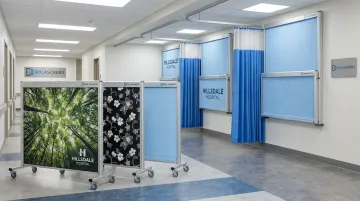
Custom heights are available. All panels are made from non-porous polyester film compatible with hospital-grade disinfectants including bleach solutions, quaternary ammonium compounds, and accelerated hydrogen peroxide.
What They're Called
These products appear under several names in clinical and procurement settings: hospital privacy screens, medical room dividers, retractable partitions, folding privacy panels, and portable privacy screens. In procurement systems and facility specs, "retractable privacy screen" and "medical room divider" are the most commonly used terms.
Key Benefits of Retractable Medical Privacy Screens
Infection Control
The most significant advantage is surface cleanability. Non-porous panels can be wiped down with EPA-registered hospital disinfectants between every patient encounter — no removal, no laundering cycle, no coverage gap.
A cleaning intervention trial found that hydrogen peroxide spray and wipes reduced day-21 MRSA contamination rates on fabric curtains from 64% (control) to 10% and 5% respectively — but cleaning had to occur every 3–4 days just to maintain that improvement. A wipe-clean hard surface eliminates that recurring burden entirely.
No independent clinical trial has yet directly compared HAI rates between rigid screens and fabric curtains — a meaningful gap in the published evidence. The infection control logic is grounded in well-established principles: smooth, nonporous materials are categorically easier to decontaminate than porous fabrics.
HIPAA Compliance in Open Spaces
HHS guidance under 45 CFR 164.530(c) confirms that cubicles, dividers, shields, curtains, or similar barriers may serve as reasonable physical safeguards in multi-patient areas. Retractable screens allow facilities to create instant visual privacy in open bays, hallways, and waiting areas without permanent construction.
No product is automatically "HIPAA compliant" — compliance depends on use and context. But screens are explicitly cited by HHS as a recognized safeguard category.
Patient Comfort and Dignity
Research supports the patient experience case. A study of 157 obstetric ED patients found that reported adequate privacy increased from 21% in curtained areas to 89% in individual cubicles, while overhearing of personal information dropped from 49% to 11%. A separate single-site ED study found curtained areas produced significantly lower overall privacy scores (P < .01).
Solid barriers signal to patients that their privacy is taken seriously, which directly affects their willingness to disclose symptoms and their overall trust in the care environment.
Operational and Cost Advantages
For facilities that need to act quickly — or can't afford construction disruption — retractable screens offer practical advantages that curtains and permanent walls don't:
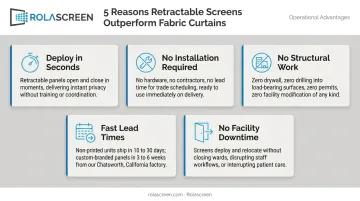
- Deploy in seconds: screens retract and extend without tools, supporting unpredictable patient flow in EDs and triage areas
- No installation required: portable units need no wall anchors, permits, or scheduled maintenance cycles
- No structural work: reconfiguring privacy coverage is a purchasing decision, not a capital project
- Fast lead times: Rolascreen ships non-printed units within 10–30 days, with expedited options for urgent needs
- No facility downtime: barriers can be repositioned or added without closing spaces or coordinating contractors
Top Settings and Use Cases
Hospitals and Emergency Departments
Multi-bed wards and open emergency bays benefit most from rapid-deploy privacy. Screens create patient-specific zones instantly, reducing visual and acoustic exposure between patients during examinations and procedures. Wall-mounted units work well for fixed bay configurations; portable units serve overflow areas and temporary care stations.
Outpatient, Specialty, and Alternative Care Settings
Open-layout environments that need on-demand privacy include:
- Physical therapy gyms and occupational therapy spaces
- Urgent care centers and walk-in clinics
- Chiropractic, acupuncture, and manual therapy offices
- Mental health counseling and behavioral health units
- Dental practices and outpatient procedure rooms
- Dialysis and infusion centers with fixed chair stations
Rolascreen has deployed in all of these settings, with clients including Kaiser Permanente, UCSF, UCLA, and Atrium Health.
Government, Military, and Disaster Relief
Beyond clinical settings, portable retractable screens hold up in temporary and high-volume environments where fast setup and easy transport matter most. Rolascreen has supplied over 200 screens to VA and military facilities and delivered 50 portable units to the Florida Department of Health for disaster shelter use.
For VA and federal procurement, domestic manufacturing matters. The FAR Buy American domestic content threshold for manufactured supplies is 65% for 2024–2028, rising to 75% in 2029. As the only U.S.-based manufacturer of retractable medical privacy screens, Rolascreen is aligned with these requirements — facilities should request compliance documentation before finalizing procurement.
What to Look for When Choosing a Retractable Medical Privacy Screen
Surface Material and Cleanability
This is the most important criterion. Prioritize screens with:
- Non-porous, smooth panel surfaces — no fabric overlays, no textured finishes
- Verified disinfectant compatibility — confirmed compatibility with the specific products your EVS team uses (bleach-based, quaternary ammonium, accelerated hydrogen peroxide)
- Minimized seams and joints — per AHE cleanability guidelines, fewer seams mean fewer places for bacteria to accumulate
Avoid anything with fabric panels or upholstered components in clinical use.
Configuration and Mounting Options
Match the product to the environment:
- Fixed layouts (dialysis bays, procedure rooms) → wall-mounted units
- Dynamic environments (EDs, triage, overflow) → portable wheeled units
- Settings requiring spatial flexibility (wrapping around beds, L-shapes) → portable units with bending capability
- Facilities needing both → hybrid units like the Rolascreen Multi
Durability, Warranty, and Domestic Supply Chain
Once you've matched the screen type to your environment, sourcing matters. Domestic manufacturers typically deliver faster lead times, simpler warranty resolution, and Buy America Act alignment for government and VA purchasers. Rolascreen manufactures in Chatsworth, California using U.S. materials and labor — and is the only U.S.-based manufacturer of retractable medical privacy screens, which matters for facilities subject to domestic procurement requirements.
Regardless of vendor, ask directly about warranty coverage (frame, panel, mechanism), the claims process, and parts availability before committing.
Customization and Branding
Panel printing allows facilities to display logos, calming imagery, wayfinding information, or department-specific branding. Rolascreen's interchangeable zippered panel system means panels can be replaced without purchasing new screens — useful for rebranding or updating imagery over time.
Custom printing works best for children's hospitals, behavioral health units, and multi-site health networks where environment directly shapes patient experience. Turnaround for custom-branded units is typically 3–6 weeks from artwork approval.
Size, Height, and Portability
Confirm before ordering:
- Panel height: 6'3" covers most adult clinical environments; 5'3" suits lower-ceiling spaces or pediatric settings
- Extended width: Verify coverage for your bay or room opening — Rolascreen units extend to 123 inches (10'3")
- Weight and caster quality for portable units that staff will move frequently
Frequently Asked Questions
How much do retractable medical privacy screens cost?
Pricing varies based on configuration (portable vs. wall-mounted), panel size, quantity, and customization. Volume pricing is available for facility-wide deployments. Contact Rolascreen directly for a facility-specific quote — lead times run 10–30 days for standard units and 3–6 weeks for custom-branded orders.
Do hospital curtains block germs?
No. Multiple clinical studies confirm that fabric curtains rapidly accumulate antibiotic-resistant bacteria including MRSA and VRE, and recontaminate within days of laundering. Porous fabric cannot be effectively disinfected between patient encounters the way a wipeable hard surface can.
What are those foldable medical privacy screens called?
They go by several names: hospital privacy screens, medical room dividers, retractable partitions, and folding privacy panels. All describe rigid or semi-rigid deployable barriers used in clinical settings as wipeable alternatives to fabric curtains.
What is the difference between retractable and portable privacy screens?
Retractable screens mount to a wall or ceiling rail and extend outward from a fixed position. Portable screens sit on wheeled freestanding frames that move freely throughout a facility. Rolascreen's Portable Elite line offers the flexibility of a freestanding unit while still retracting fully when not in use.
Can retractable medical privacy screens be customized with facility branding?
Yes. Many manufacturers, including Rolascreen, offer full-panel custom printing with logos, photography, calming artwork, or wayfinding imagery. Rolascreen's interchangeable panel system allows panels to be swapped out without replacing the entire screen frame, which reduces long-term rebranding costs.