
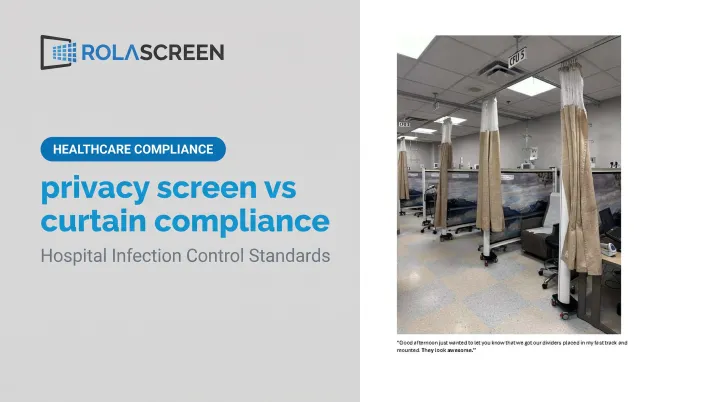
The choice between a retractable privacy screen and a fabric curtain was once treated as a budget question. It's now a compliance question. These two solutions differ meaningfully in how they perform across infection control, fire safety, and patient privacy requirements — and those differences carry real operational and regulatory consequences.
This article breaks down both options objectively, using verified research and regulatory standards, so facility managers and infection control officers can make an informed decision before their next survey cycle.
Key Takeaways
- A 2012 study found 95% of hospital curtains contaminated with pathogens, including 21% positive for MRSA
- Fabric curtains follow NFPA 101's textile flame-propagation pathway — they are not automatically classified as noncombustible or limited-combustible materials
- HIPAA permits curtains as a reasonable visual safeguard, but they provide minimal auditory separation in open care environments
- Retractable screens wipe down between patients without removal, eliminating linen laundering costs
- Curtains suit stable, low-turnover settings only when change-out documentation is consistently maintained
Privacy Screen vs. Hospital Curtain: Quick Compliance Comparison
Before diving into each solution, here's how they stack up across the four dimensions that matter most during surveys:
| Compliance Dimension | Hospital Privacy Curtain | Retractable Privacy Screen |
|---|---|---|
| Infection Control | Porous fabric harbors MRSA, VRE, C. diff; requires laundering | Non-porous surface; wipe-down with hospital disinfectants between patients |
| Fire Safety (NFPA 101) | Tested under flame-propagation standard (NFPA 701); not automatically limited-combustible | Depends on material — clinical-grade polyester film requires product-specific fire test documentation |
| HIPAA / Visual Privacy | Provides visual separation; limited auditory protection | Rigid or semi-rigid panels improve visual and some auditory privacy |
| Maintenance Burden | Removal, laundering, reinstallation required; ~15 min per change-out | Surface wipe; no linen management |
| Reconfiguration | Fixed to ceiling tracks; repositioning requires construction | Portable units deploy anywhere in seconds; wall-mounted units install without ceiling work |
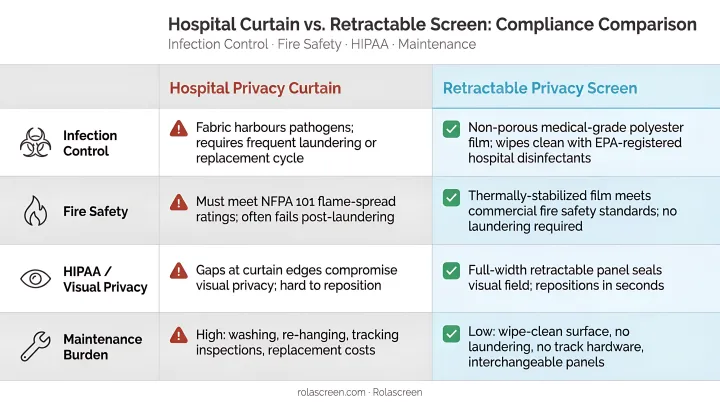
The operational and documentation burden of curtains is measurably higher — and it compounds in high-turnover environments like EDs and dialysis bays where patient throughput is constant. The sections below break down each compliance dimension in detail.
What Is a Medical Privacy Screen?
A medical privacy screen is a retractable or portable partition designed for clinical environments. Modern versions use non-porous film panels housed in a retractable mechanism — the screen extends to create a patient bay and retracts flush to the wall or into its base when not needed.
Core Compliance Features
The compliance case for retractable screens centers on their surface material. Non-porous polyester film doesn't absorb fluids, doesn't harbor biofilm, and can be disinfected with standard hospital-grade wipes between patients. This aligns with Joint Commission Infection Control (IC) chapter expectations for reusable patient care equipment — cleanability without removal.
For fire safety, the classification depends on the specific material and available test documentation. Clinical-grade materials may qualify under NFPA 101's limited-combustibility criteria when tested under ASTM E84 or ASTM E136, but facilities should request product-specific fire test reports from any vendor before a survey.
Two Main Configurations
- Wall-mounted retractable — mounts directly to the wall (no ceiling modification required), extends up to 18 inches from the wall surface, retracts flush when not in use; suited for permanent patient bays in dialysis centers, exam rooms, and semi-private rooms
- Portable freestanding — wheeled base with locking casters, deploys in seconds without installation; suited for ED triage, overflow capacity, surge response, and any area requiring rapid reconfiguration
Use Cases
Rolascreen, the only US-based manufacturer of retractable medical privacy screens, has placed units in 900+ hospitals, clinics, and schools across 47 states. Deployments span emergency departments, multi-patient recovery bays, VA and military facilities, COVID isolation overflow areas, outpatient rehab spaces, and school health clinics — with over 35% of healthcare customers placing repeat orders.
What Is a Hospital Privacy Curtain?
Hospital privacy curtains are fabric panels suspended from ceiling-mounted tracks — the default patient separation solution for decades in multi-bed rooms, emergency bays, and procedure areas.
The Infection Control Problem
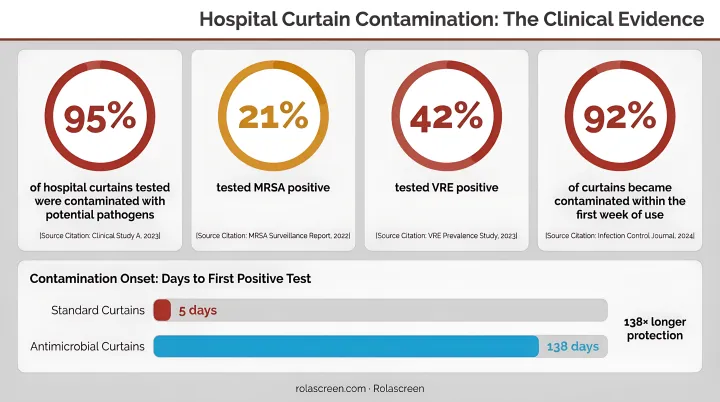
The contamination evidence for fabric curtains is well-documented. A foundational 2012 study of 43 hospital curtains found:
- 95% were contaminated with potentially pathogenic bacteria
- 21% tested positive for MRSA
- 42% tested positive for VRE
- 92% showed contamination within the first week after installation
A 2019 ten-hospital multicenter study found that standard curtains reached initial MDRO contamination at a median of 5 days, compared to 138 days for one treated-curtain formulation tested.
Porous fibers provide surface area for biofilm adhesion that no amount of spot-wiping can adequately address. The material itself is the problem.
The Fire Safety Concern
Hospital fabric curtains don't automatically meet NFPA 101's noncombustible or limited-combustible material definitions. Their compliance pathway runs through the hanging-textile flame-propagation test under NFPA 701, a different and less stringent standard than ASTM E136 or ASTM E84. Plastic sheeting alternatives like polyethylene film face similar classification problems. Facilities using unapproved materials as patient barriers carry a documentable fire safety gap.
The Operational Burden
A 2023 military hospital study modeled curtain change-out at 15 minutes per panel (covering removal, transport to laundry, and reinstallation). In a model comparing standard versus treated curtains over 20 weeks, standard curtains required 105 change-outs versus 2, generating an estimated $7,722 in additional costs over that period at a single site. Multiply that across a multi-unit facility, and laundering costs become a significant budget line.
Where Curtains Still See Use
Curtains remain common in:
- Permanent multi-bed inpatient rooms with fixed ceiling tracks already installed
- Long-term care settings with stable patient census and manageable change-out frequency
- Lower-acuity areas where change-out protocols are consistently documented
The regulatory pressure is increasing even in these settings. Accreditation bodies now require documented cleaning intervals, material specifications, and change-out logs — adding administrative overhead to an already labor-intensive product.
Privacy Screen vs. Curtain: Which Is Better for Compliance?
Most healthcare facilities are evaluated across three compliance pillars: infection control (IC), fire and life safety (LS/NFPA 101), and patient rights including privacy (RI/HIPAA). Here's how each solution performs:
Infection Control
The Joint Commission's IC chapter standards require reusable patient care equipment to be cleanable without compromising the item or creating a transmission risk. Fabric curtains satisfy this through laundering — but laundering requires removal, and contamination data shows measurable pathogen accumulation within days of installation.
Non-porous screen surfaces can be wiped between every patient without removal. No laundering cycle. No pathogen-harboring fabric surface.
Fire and Life Safety
NFPA 101 classifies materials for temporary barriers under noncombustible (ASTM E136) and limited-combustible (ASTM E84/NFPA 259) criteria. Fabric curtains are evaluated under the NFPA 701 flame-propagation pathway, which doesn't confer limited-combustible classification. Facilities using plastic sheeting as a curtain alternative face additional risk — polyethylene and similar films are not automatically compliant either.
For retractable screens, compliance comes down to the materials used and available test documentation. Facilities should ask vendors for ASTM fire test reports before survey.
HIPAA and Patient Privacy
HHS guidance confirms that soundproof rooms are not required under HIPAA. Curtains, screens, lowered voices, and physical separation all qualify as reasonable safeguards. Neither product alone guarantees auditory privacy.
That said, rigid or semi-rigid screen panels provide better sound attenuation than fabric — relevant in open emergency bays and multi-station treatment areas where clinical conversations happen at close range.
Note: HCAHPS currently has no privacy-specific measure tied to reimbursement. Don't let vendors claim a direct curtain-to-payment-penalty connection — the evidence doesn't support it.
Lifecycle Cost Reality
| Cost Factor | Hospital Curtain | Retractable Screen |
|---|---|---|
| Upfront cost | Lower | Higher |
| Laundering cost | Per change-out, recurring | None |
| Labor (change-out) | ~15 min per panel | Wipe-down only |
| Replacement cycle | Fabric degrades; periodic replacement | Panels are interchangeable |
| Linen management | Required | Not applicable |
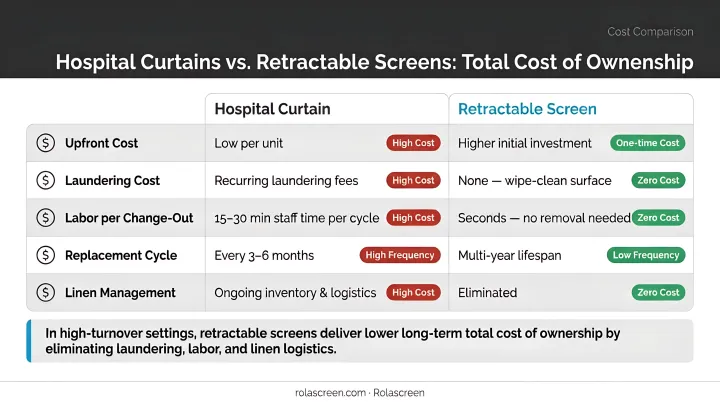
Curtains appear cheaper at purchase. Over a multi-year lifecycle in a high-turnover environment, the laundering, labor, and replacement costs typically exceed the initial cost difference.
Situational Recommendation
Cost and compliance data together point to clear use cases for each option:
- Use retractable privacy screens in ERs, ICUs, post-op recovery bays, VA/military facilities, and any high-turnover environment where curtain change-out frequency is difficult to sustain
- Curtains may remain viable in stable inpatient rooms with fixed ceiling tracks, where patient turnover is low and change-out documentation is rigorously maintained
Real-World Example: How Healthcare Facilities Are Making the Switch
Compliance pressure often drives the switch — and timing matters. When the Florida Department of Health needed patient privacy barriers for disaster shelters ahead of hurricane season, they turned to Rolascreen for 50 Portable Elite units, delivered within 4 weeks. No construction. No ceiling modifications. Units deployed same-day upon arrival.
During the COVID-19 surge, VA and military facilities procured 200+ Rolascreen units — primarily Portable Elite — for rapid deployment into converted non-clinical spaces. Three factors drove those procurement decisions:
- Non-porous surfaces that meet infection control standards in high-density environments
- Buy American Act alignment, a hard requirement for federal procurement
- Same-day deployment with no installation, permits, or construction
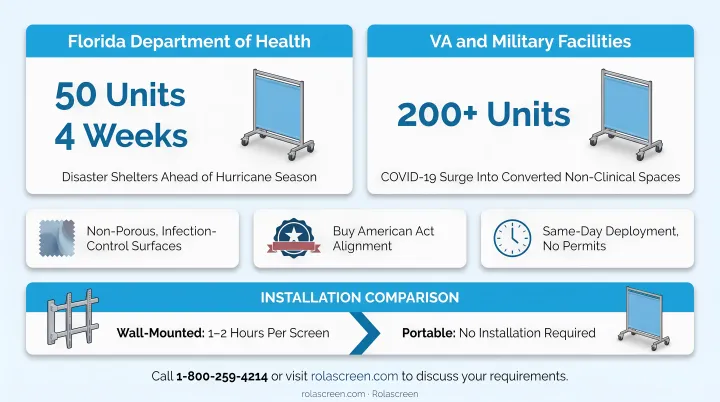
Both cases reflect a pattern Rolascreen encounters regularly: a facility under survey pressure with curtain-related findings — contamination documentation gaps or material compliance questions — that needs a fast, construction-free resolution. Wall-mounted units install in 1–2 hours per screen without ceiling modifications or permits. Portable units require no installation at all.
If your facility is navigating a compliance transition, Rolascreen's team offers product consultations and architectural documentation support. Reach them at rolascreen.com or call 1-800-259-4214 to discuss your requirements and get a quote.
Conclusion
Privacy curtains carry documented compliance risk across three dimensions that Joint Commission surveyors actively scrutinize:
- Infection control: Porous fabric accumulates pathogens rapidly between launderings
- Fire safety: Flame-propagation testing does not confer limited-combustible classification under NFPA 101
- Operational sustainability: Required laundering frequency strains infection control protocols in practice
Retractable medical privacy screens address each of those gaps — though facilities should verify material-specific fire test documentation with any vendor rather than accepting general compliance claims.
For facility managers preparing for 2026 survey cycles, the practical question is: can your current privacy solution be documented as meeting Joint Commission IC, LS, and RI chapter requirements? If curtain change-out logs, material specs, and laundering protocols aren't consistently maintained, that documentation gap becomes a citation risk during survey — one that a non-porous, wipeable screen with a traceable cleaning log eliminates entirely.
Frequently Asked Questions
Are hospital privacy curtains HIPAA compliant?
Curtains can serve as a reasonable visual safeguard under HIPAA, which doesn't require soundproof rooms. The limitation is auditory: fabric curtains provide minimal sound attenuation, creating potential spoken PHI exposure risk in open multi-station environments. Whether curtains satisfy HIPAA in a specific setting depends on the physical layout and what other reasonable precautions are in place.
What makes a privacy screen compliant with NFPA 101?
NFPA 101 requires temporary barriers to use noncombustible or limited-combustible materials, tested under ASTM E136 or ASTM E84/UL 723 respectively. Products need material-specific test documentation to support this classification; general descriptions like "polyester film" don't automatically qualify. Request fire test reports from your vendor before any survey.
How often do hospital privacy curtains need to be replaced or laundered?
No universal US interval governs this — frequency is policy- and setting-specific. The Joint Commission's 2025 Nursing Care Center guide requires change-out when visibly soiled, while high-turnover settings like ERs may require change-out after every patient contact. MRSA and VRE contamination can occur within the first week after installation.
Can retractable privacy screens be used in ICUs or sterile environments?
Yes. Non-porous retractable screens are well-suited to high-acuity areas because they can be disinfected between patients with hospital-grade wipes without removal or laundering. This makes them more compatible with the cleaning protocols required in ICU and post-op recovery settings than fabric curtains.
Do retractable privacy screens meet Joint Commission survey standards?
Screens with cleanable, non-porous surfaces align with Joint Commission IC chapter expectations for reusable equipment. Facilities should request material specifications and fire test documentation from their vendor and document the compliance basis before any survey. Surveyors increasingly want to see the paperwork, not just the product.
What is the long-term cost difference between privacy screens and curtains?
Curtains carry recurring costs: laundering, staff labor for change-outs, and periodic fabric replacement. One 2023 military hospital model estimated over $20,000 in annual laundering and labor savings from reducing standard curtain change-outs. Retractable screens have higher upfront costs but minimal ongoing expense, resulting in lower total cost of ownership over a multi-year period in high-turnover settings.